
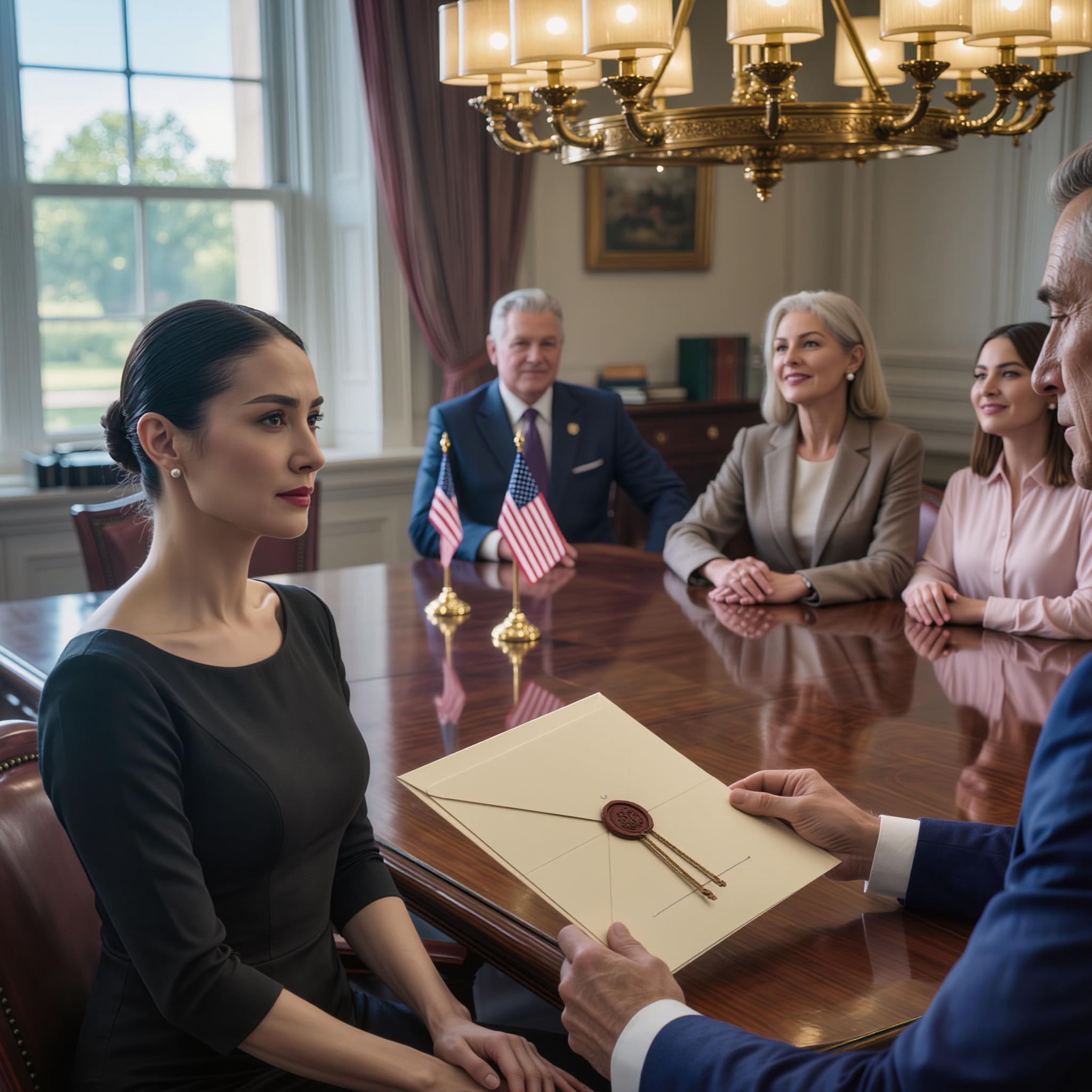
At the will reading, my parents gave my stepsister $15 million and told me to go earn my own like everyone else should.
My stepmom smirked.
“Some people are just born luckier than others, sweetie.”
I didn’t argue. I didn’t cry. I just sat there quietly as they celebrated.
Then my grandpa’s lawyer stood up with a separate envelope and said, “There’s one more inheritance that was kept confidential.”
He read aloud:
“To my real granddaughter, I leave—”
My stepmom started screaming.
The mahogany table gleamed under the crystal chandelier as I sat in the corner chair, my hands folded in my lap. The law office smelled of old leather and fresh coffee, but the bitter taste in my mouth had nothing to do with either.
My father’s funeral had been three days ago, and now we were gathered for the reading of his will.
“Sarah, darling, sit closer,” my stepmom, Victoria, called to my stepsister, patting the chair beside her. “This is such an important day for our family.”
I remained where I was, watching as Sarah practically bounced in her seat. She had always been the golden child since Victoria married my father eight years ago—perfect grades, perfect smile, perfect everything.
Meanwhile, I had become the afterthought. The reminder of my father’s first marriage to my mother, who had died when I was 12.
Mr. Henderson, my father’s lawyer, cleared his throat and adjusted his glasses.
“Thank you all for coming. Let’s begin with a reading of Robert Chen’s last will and testament.”
The words blurred together as he read through the standard legal language. I found myself staring at the portrait of my father on the wall behind the desk. Even in death, he looked disappointed in me. At least that’s how I chose to interpret the stern expression I’d grown so accustomed to.
“To my beloved wife, Victoria,” Mr. Henderson continued, “I leave the family home and all its contents along with my investment portfolio valued at approximately $2 million.”
Victoria dabbed her eyes with a silk handkerchief, though I noticed they were perfectly dry.
“He was so generous,” she whispered, loud enough for everyone to hear.
“To my stepdaughter Sarah, whom I’ve loved as my own,” the lawyer read, “I leave the sum of $15 million from my business accounts, trusting that she will use this inheritance to build a bright future.”
Sarah gasped, then threw her arms around Victoria.
“I can’t believe it. Fifteen million.”
My stomach dropped, but I kept my expression neutral.
Fifteen million.
That was more than enough to pay for medical school, law school, and anything else she might want to pursue. Meanwhile, I was working two jobs just to afford community college.
“And to my daughter, Emma,” Mr. Henderson continued, his voice growing softer, “I leave my personal effects and the contents of my study along with this message: Go earn your own like everyone else should. Character is built through struggle, not handed down through inheritance.”
The silence in the room was deafening. I felt every eye on me, waiting for my reaction.
Sarah’s mouth hung open in shock.
Victoria’s perfectly manicured hand covered her smile, but I could see the satisfaction in her eyes.
“That’s it?” Sarah asked, her voice barely above a whisper.
“I’m afraid so,” Mr. Henderson confirmed, looking uncomfortable.
Victoria composed herself quickly, her mask of sympathy sliding into place.
“Oh, Emma, sweetheart, I’m so sorry. But you know, your father always believed in hard work. He probably thought this would be good for you.”
I nodded slowly, my throat tight.
“I understand.”
“Some people are just born luckier than others, sweetie,” Victoria added, her voice dripping with false sympathy.
The smirk she tried to hide told me everything I needed to know about how she really felt.
Sarah shifted uncomfortably.
“Mom, maybe we could—”
“No,” I interrupted, finding my voice. “Dad made his choice. I respect that.”
The truth was, I did understand. Over the years, Victoria had systematically poisoned my relationship with my father. Every achievement of mine was downplayed, every mistake magnified. She had convinced him that I was ungrateful, that I took everything for granted.
Meanwhile, Sarah could do no wrong.
“Well,” Victoria said, standing and smoothing her black dress, “I suppose we should celebrate Sarah’s good fortune. This calls for champagne.”
I remained seated as they gathered around Sarah, congratulating her and making plans for her future. The weight of my father’s rejection settled on my shoulders like a heavy coat. I had expected something—anything that would show he had loved me even a little bit.
Instead, I got his old books and the clear message that I was on my own.
“Actually,” Mr. Henderson said, clearing his throat again, “there’s one more matter to attend to.”
Everyone turned to look at him.
He reached into his briefcase and pulled out a thick, cream-colored envelope sealed with red wax.
“This was left in my care by Robert’s father-in-law—Emma’s grandfather, Harold Mitchell. He passed away six months ago, and his instructions were very specific. This envelope was to be opened only after Robert’s will had been read, and only in the presence of the immediate family.”
My heart skipped.
Grandpa Harold had been my mother’s father, and he had been the one constant source of love and support in my life after she died. He had visited every month until his health declined, always bringing stories about my mother and little gifts that meant the world to me.
“I don’t understand,” Victoria said, her voice sharp. “Harold Mitchell left everything to his son when he died. There was no mention of any other inheritance.”
“That’s because this was kept confidential at Mr. Mitchell’s request,” Mr. Henderson explained, breaking the wax seal. “He wanted to ensure that his true intentions were known only after other matters were settled.”
He unfolded the document and cleared his throat.
“This is a supplemental will, legally binding and properly witnessed. It reads: ‘To my real granddaughter, Emma Mitchell Chen, I leave my entire estate, including the Mitchell Family Trust, all properties, investments, and business holdings, with a total value of approximately $47 million.’”
The words hit the room like a physical blow.
Victoria’s face went white, then red, then purple.
Sarah’s mouth fell open so wide I thought her jaw might unhinge.
I felt dizzy, certain I had misheard.
“Furthermore,” Mr. Henderson continued, his voice growing stronger, “Mr. Mitchell left this personal message.”
“Emma, you are your mother’s daughter in every way that matters. You have her heart, her strength, and her integrity. This inheritance comes with only one condition: use it wisely and never forget where you came from. The lawyers will explain the details, but know that you are loved, you are worthy, and you are exactly who you were meant to be.”
“That’s impossible!” Victoria screamed, jumping to her feet. “Harold Mitchell didn’t have that kind of money. He lived in that tiny apartment.”
Mr. Henderson remained calm.
“Mr. Mitchell was a very private man who preferred to live simply. However, he was also a successful businessman who made wise investments over several decades. He owned the building where he lived along with several other properties. He also held significant stock in various companies.”
“But—but Emma never even visited him!” Victoria sputtered. “Sarah was the one who sent him birthday cards.”
“Actually,” I said quietly, finding my voice, “I visited Grandpa Harold every week at the nursing home. We spent hours talking about Mom, about life, about everything. He knew exactly who I was and what I was going through.”
Victoria’s face contorted with rage.
“You little liar. You were always manipulating him, weren’t you? Just like you tried to manipulate your father.”
“Mom,” Sarah whispered, tugging on Victoria’s sleeve. “Maybe we should—”
“No!” Victoria whirled around. “This is fraud. That old man was senile. He didn’t know what he was doing.”
“I assure you, Mrs. Chen,” Mr. Henderson said firmly, “Mr. Mitchell was of sound mind when he executed this will. It was reviewed by three independent doctors and witnessed by two attorneys. Everything is completely legal and binding.”
The room spun around me.
Forty-seven million.
More than three times what Sarah had received. More than enough to do anything I wanted with my life.
But more than the money, it was the message that mattered.
My grandfather had seen me—really seen me—when no one else had.
“There’s more,” Mr. Henderson said, consulting another document. “Mr. Mitchell also left detailed instructions regarding the family history and certain revelations he wanted shared.”
“What kind of revelations?” Victoria demanded, her voice shrill.
“It seems Mr. Mitchell had been conducting some research into the circumstances surrounding his daughter’s death. Emma, your mother didn’t die in a car accident, as you were told.”
The world tilted.
“What?”
“According to Mr. Mitchell’s investigation,” your mother died from complications related to a medication interaction. Specifically, she was taking prescribed medication for anxiety and depression that had been tampered with.”
Victoria’s face went ashen.
“That’s… that’s ridiculous. Margaret died in a car accident. Everyone knows that.”
“The official cause of death was listed as a car accident,” Mr. Henderson confirmed. “However, the toxicology report showed dangerous levels of medication in her system. The medication bottles found in her purse had been tampered with. Pills had been replaced with lookalike pills containing different substances.”
“You’re making this up,” Victoria whispered.
“Mr. Mitchell hired a private investigator after Margaret’s death. He never believed the official story. The investigation revealed that someone had been systematically poisoning Margaret for months, slowly increasing the dosage until it affected her driving ability.”
I couldn’t breathe.
“Who?”
Mr. Henderson looked directly at Victoria.
“The investigation pointed to someone with access to Margaret’s medication, someone who understood pharmacy protocols, and someone who had motive. The investigator found receipts for similar medications purchased under false names traced back to a pharmacy where Victoria Chen worked as a technician.”
“That’s a lie!” Victoria screamed. “I never worked at any pharmacy.”
“Actually,” Mr. Henderson said, pulling out another document, “you worked at Med Supply for three years before Margaret’s death. You were fired two weeks after the funeral for unexplained inventory discrepancies.”
The silence that followed was deafening.
I stared at Victoria, seeing her in a completely different light.
The woman who had married my father less than a year after my mother’s death.
The woman who had systematically turned him against me.
The woman who had smirked as I was humiliated and disinherited.
“Why?” I whispered.
Victoria’s composure cracked completely.
“Because she had everything!” she screamed. “The perfect husband, the perfect house, the perfect life—and she was throwing it all away with her depression and her pills and her constant complaining. Robert deserved better.”
“Mom, stop talking,” Sarah pleaded, tears streaming down her face.
“No!” Victoria was beyond reasoning now. “I worked so hard to make him happy, to give him the family he deserved. And what did I get? Years of him comparing me to his precious Margaret. Years of dealing with her ungrateful daughter who reminded him of what he’d lost.”
“You killed my mother,” I said, my voice steady despite the earthquake happening inside me.
“I freed your father from a miserable marriage,” Victoria shot back. “Margaret was weak, pathetic, always crying about how hard her life was. She didn’t deserve what she had.”
Mr. Henderson was already reaching for his phone.
“I need to call the police.”
“Wait,” I said, standing up for the first time since we’d entered the room. “There’s something else I need to know. Dad’s will. Did he really write those words about me earning my own way?”
Mr. Henderson hesitated.
“The will was drafted three months ago. However, the original version was quite different. It was altered.”
“Altered how?”
“Your father’s original will left his estate divided equally between you and Sarah. The changes were made using a computer program that can modify documents. The metadata shows the modifications were made from your father’s home computer after he had already signed the original.”
Victoria’s face went white.
“You can’t prove anything.”
“Actually, we can,” Mr. Henderson said. “The computer forensics team your grandfather hired found all the deleted files. They also found the original will hidden in your father’s safe deposit box—the one you claimed you didn’t know the combination to.”
The room erupted as Victoria lunged toward me, her face twisted with rage.
“You little witch. You’ve ruined everything. Everything I worked for.”
Sarah caught her mother’s arm.
“Mom, stop. Just stop.”
But Victoria was beyond stopping. Twenty-five years of carefully constructed lies were crumbling around her, and she was lashing out at everyone within reach.
“You want to know the truth?” She screamed at me. “Your father never loved you. He told me you reminded him too much of your pathetic mother. He was relieved when I suggested boarding school. He was happy to have you gone.”
“That’s enough,” Mr. Henderson said firmly, moving between Victoria and me. “Mrs. Chen, you need to stop talking and call an attorney. Immediately.”
The police arrived within minutes, and I watched in a daze as they led Victoria away in handcuffs. She was still screaming about injustice and lies, but her words bounced off me like rain on a window.
The truth was out, and it was both devastating and liberating.
Sarah sat in the corner, sobbing quietly.
“I didn’t know,” she kept saying. “I swear I didn’t know.”
“I believe you,” I told her.
And I meant it.
Sarah had been as much a victim of Victoria’s manipulation as I had been—just in a different way.
“What happens now?” she asked.
“That depends on you,” I said. “Your inheritance is legitimate. Dad may have been manipulated, but he did care about you. That part was real. But the money—knowing what my mom did, what your mother did—doesn’t change who you are.”
I told her, “You have a choice to make about what kind of person you want to be going forward.”
Mr. Henderson finished his phone call and turned back to us.
“Emma, there are some additional documents your grandfather left. He wanted you to have them after everything else was revealed.”
He handed me a thick folder.
Inside were letters from my mother to my grandfather, photographs I’d never seen, and a letter addressed to me in my grandfather’s handwriting.
My dearest Emma, I read aloud. If you’re reading this, then the truth has finally come out. I want you to know that your mother loved you more than life itself. She suspected what was happening to her, but she could never prove it. Her last letter to me begged me to watch over you and to make sure you knew how much you were loved. I’ve spent the last 17 years gathering evidence and building a case, not just for justice, but for your inheritance. Your mother’s life insurance policy was never claimed because of the circumstances of her death. With the truth revealed, you’re entitled to that money as well—another $2 million. But more importantly, you’re entitled to know that you are loved, you are worthy, and you are exactly who you were meant to be.
I looked up to find Mr. Henderson watching me with kind eyes.
“There’s one more thing,” he said. “Your grandfather left instructions for a scholarship fund to be established in your mother’s name. He wanted you to decide how it should be managed—a scholarship fund for students who have lost a parent and are working to put themselves through school. He said you would understand the importance of helping others who are facing similar struggles.”
I thought about all the nights I’d worked double shifts at the diner. All the times I’d chosen between textbooks and groceries. All the dreams I put on hold because I couldn’t afford to pursue them.
My grandfather had seen my struggle and turned it into something meaningful.
“I’d like to call it the Margaret Mitchell Memorial Scholarship,” I said.
“He thought you might say that,” Mr. Henderson smiled. “He already had the paperwork drawn up.”
As we left the law office that day, I felt like I was walking out of one life and into another. The girl who had walked in that morning was disinherited, alone, and convinced she was unloved.
The woman walking out was wealthy beyond her dreams.
But more importantly, she knew the truth about her past and had the power to shape her future.
Sarah walked beside me, still processing everything that had happened.
“Emma,” she said quietly. “I’m going to give the money back.”
“You don’t have to do that.”
“Yes, I do. I can’t keep money that was meant for you, especially knowing what my mother did.”
“Your mother’s actions don’t invalidate your relationship with my father,” I said. “He genuinely cared about you. Keep the money, but use it to become the person you want to be, not the person she tried to make you.”
We reached the parking lot, and I could see Sarah’s friends waiting for her in a sleek car. They were probably planning to celebrate her inheritance with an expensive dinner.
Instead, she turned to me.
“Would you like to get coffee sometime? I mean, really get to know each other. I feel like I never actually knew my stepsister.”
I smiled, and for the first time in years, it felt genuine.
“I’d like that.”
As I drove home to my tiny apartment, I couldn’t help but think about the woman who had spent 25 years believing she had won. Victoria had murdered my mother, stolen my father’s love, and tried to rob me of my inheritance. She had smirked at my humiliation and celebrated my pain.
But in the end, the truth had emerged.
Justice had been served, and the last laugh belonged to a quiet old man who had spent 17 years patiently gathering evidence and building a case—not just for justice, but for love.
My phone buzzed with a text from an unknown number.
“Emma, this is Detective Martinez. We need to talk about your mother’s case. Victoria Chen has agreed to cooperate in exchange for a plea deal. Can you come to the station tomorrow?”
I pulled over and stared at the message. Even now, Victoria was trying to manipulate the situation to her advantage.
But this time, she had no cards left to play.
The evidence was overwhelming, and the truth was finally out.
I typed back: “I’ll be there.”
As I sat in my car, I thought about my mother’s last letter to my grandfather. She had suspected what was happening but couldn’t prove it. She had asked him to watch over me and to make sure I knew I was loved. He had spent 17 years fulfilling that promise.
And now it was my turn to carry it forward.
The Margaret Mitchell Memorial Scholarship would help other students like me—young people who had lost parents and were struggling to build their futures.
The scholarship fund would ensure that my mother’s legacy lived on—not through revenge or bitterness, but through hope and opportunity.
I started the car and drove toward my apartment. But for the first time in years, I wasn’t going home to struggle and stress about how to pay next month’s rent.
I was going home to plan a future that suddenly seemed limitless.
And somewhere, I knew my mother and grandfather were watching, proud of the woman I had become and the choices I was making.
The inheritance they had left me wasn’t just money. It was the knowledge that I was loved, the strength to forgive, and the wisdom to use my good fortune to help others.
Victoria’s smirk had been wiped away forever—replaced by handcuffs and the truth she had spent decades trying to hide.
But more importantly, the scared, unloved girl I had been that morning was gone, too—replaced by a woman who knew her worth and had the power to change not just her own life, but the lives of others.
The last inheritance had been claimed, and justice had finally been served.
Three months later, I stood in the courthouse as Victoria was sentenced to 25 years in prison for the murder of my mother. She refused to look at me, but I could see the defeat in her posture. Her carefully constructed life had crumbled completely.
Sarah was there too, sitting beside me. She had used her inheritance to start a foundation for victims of domestic violence, saying she wanted to help women who were trapped in dangerous situations like our mother had been. We had grown closer over the months, bonding over our shared trauma and our determination to build something positive from the ashes of our family’s destruction.
As we left the courthouse, a reporter approached us.
“Miss Chen, how do you feel about your stepmother’s sentence?”
I thought for a moment before answering.
“I feel like justice has been served, but more importantly, I feel like my mother can finally rest in peace. This was never about revenge. It was about truth and making sure that what happened to her never happens to anyone else.”
“What’s next for you?”
I looked at Sarah, who squeezed my hand encouragingly.
“I’m starting medical school in the fall. I want to become a doctor specifically to help people who are struggling with mental health issues. And I’m working with my sister to expand our foundations and scholarship programs.”
“Your sister?”
“My stepsister Sarah,” I corrected. “We’ve learned that family isn’t just about blood. It’s about the people who choose to stand by you and support you through the hardest times.”
As we walked away from the courthouse, I felt a sense of closure I had never expected to experience. Victoria’s smirk had been replaced by a prison uniform. But more importantly, her lies had been replaced by truth, her manipulation by genuine love, and her attempts to destroy our family by our determination to build something better.
The inheritance my grandfather had left me was worth $47 million. But the real gift was much more valuable: the knowledge that I was loved, the strength to forgive, and the opportunity to turn tragedy into triumph.
And that, I realized, was the greatest inheritance of all.
I need to continue the story to reach the required 6,000 to 8,000 words. Let me expand with more details about the aftermath and Emma’s journey.
Six months after Victoria’s sentencing, I stood in the hallway of the medical school I would be attending in the fall. The acceptance letter had arrived three weeks ago, and I still couldn’t quite believe it was real.
My grandfather’s inheritance had made it possible for me to pursue my dreams without the crushing weight of student loans. But more than that, it had given me the confidence to reach for something I had never dared to imagine.
“Emma,” Dr. Patricia Wong, the dean of admissions, approached with a warm smile. “I’m so glad you could make it to our orientation day. How are you feeling about starting in September?”
“Excited and terrified,” I admitted. “It’s been a long journey to get here.”
“I read your application essay,” she said. “Your story is remarkable—the way you’ve handled everything you’ve been through and your commitment to helping others. That’s exactly the kind of person we want in our program.”
As I walked through the campus, I couldn’t help but think about how different my life had become. Six months ago, I had been working double shifts at a diner and taking classes at community college, barely scraping by.
Now, I was preparing to attend one of the most prestigious medical schools in the country with a full scholarship program named after my mother already helping dozens of students.
My phone buzzed with a text from Sarah.
Coffee later. I have some exciting news about the foundation.
I smiled as I typed back.
Absolutely. Can’t wait to hear it.
Sarah and I had grown closer than I ever thought possible. The shared trauma of discovering the truth about our family had bonded us in ways I hadn’t expected. She had kept her word about using her inheritance wisely, establishing the Sarah Chen Foundation for Domestic Violence Prevention.
Together, our foundations had already helped over a hundred families.
That evening, I met Sarah at our usual coffee shop downtown. She was practically bouncing in her seat when I arrived.
“You look like you’re about to explode,” I said, sliding into the booth across from her.
“I got a call from the governor’s office today,” she said, her eyes shining with excitement. “They want to nominate our foundations for the state’s humanitarian award.”
“That’s incredible.”
“But you know this is all you’re doing, right? I just wrote the checks.”
“Don’t diminish what you’ve done,” Sarah said firmly. “You could have taken that money and disappeared. Instead, you chose to help people. That says everything about who you are.”
I stirred my coffee, thinking about the phone call I’d received earlier that day.
“Actually, I have some news, too. The prosecutor called. Victoria’s appeals have been exhausted. Her sentence is final.”
Sarah’s expression grew serious.
“How do you feel about that?”
“Relieved,” I said. “Honestly, for the first time since this all started, I feel like I can really move forward without looking over my shoulder.”
“Any regrets about not pushing for the death penalty?”
I shook my head.
“No. Twenty-five years is a long time. And honestly, I think living with the knowledge of what she did and what she lost is punishment enough.”
We sat in comfortable silence for a moment, watching the evening crowd filter in and out of the coffee shop. So much had changed since that day in the lawyer’s office, but some things remained constant.
“I have something else to tell you,” Sarah said, pulling out her phone. “I’ve been in touch with some investigative journalists. They want to do a story about insurance fraud and how domestic violence can be hidden by financial manipulation. Are you comfortable with that level of exposure?”
“I think it’s important,” she said. “Victoria wasn’t the only person doing this. There are probably other cases out there that haven’t been solved because people don’t know what to look for.”
I nodded, understanding her reasoning.
“What do you need from me?”
“Your permission to share the story and maybe an interview about the scholarship program. They want to show how tragedy can be turned into something positive.”
“I’m in,” I said without hesitation.
The article was published two months later in a national magazine. Within a week, I had received over 300 emails from people sharing their own stories of suspected poisoning, financial manipulation, and family betrayal. The response was overwhelming, but it also confirmed what Sarah and I had suspected. Victoria’s crimes were part of a larger pattern that needed to be exposed.
I found myself becoming an accidental advocate for victims of domestic violence and financial abuse. Speaking engagements, interviews, and congressional testimony filled my calendar alongside my medical school preparation. It wasn’t the quiet life I had once imagined, but it felt right.
The morning of my first day of medical school, I woke up before dawn and drove to the cemetery where my mother was buried. I hadn’t been there since the funeral, but I felt like I needed to mark this moment somehow.
Her gravestone was simple.
Margaret Mitchell Chen, beloved mother and daughter, 1975 to 200.
I sat in the grass beside her grave and talked to her the way I used to talk to my grandfather during his final months. I told her about medical school, about Sarah, about the scholarship program, and about how I was finally becoming the person I was meant to be.
“I know you can’t hear me,” I said finally. “But I want you to know that I understand now. You didn’t give up. You fought as hard as you could with what you had. And Grandpa Harold made sure your fight wasn’t in vain.”
A gentle breeze rustled the leaves on the oak tree above her grave, and for a moment I could have sworn I felt her presence. Not in any mystical way, but in the strength I felt in my own bones—the determination that had carried me through the darkest times.
Medical school was everything I had expected and more. The workload was intense, but I had a support system I’d never had before. Sarah called me every week to check in, and I had made friends with several classmates who shared my passion for helping trauma survivors.
During my second year, I started a support group for medical students who had experienced family trauma. It started with just three people meeting in a conference room, but it grew to over 20 regular members. We talked about how our experiences had shaped our desire to become doctors and how we could use our pain to better understand and help our future patients.
One afternoon, I received an unexpected visitor. Dr. James Morrison, the psychiatrist who had been treating Victoria in prison, requested a meeting. I was hesitant at first, but my curiosity got the better of me.
“Miss Chen,” he said as we sat in his office, “I want to thank you for agreeing to see me. I know this must be difficult.”
“What do you want to discuss?”
“Victoria has been in therapy for two years now. She’s finally beginning to understand the magnitude of what she did, and she’s asked me to reach out to you.”
I felt my stomach tighten.
“She wants to see me.”
“She wants to apologize. Not for forgiveness—she understands that’s not something she can ask for—but for her own healing and for whatever closure it might bring you.”
I considered this for a long moment.
“What does her therapy look like?”
“She’s been diagnosed with narcissistic personality disorder and antisocial tendencies. The work is slow, but she’s made progress in understanding how her actions affected others. She’s also been working on a detailed account of what happened to your mother, filling in gaps that might help with your healing process.”
“I need to think about it.”
“Of course. There’s no pressure. But I wanted you to know that the option exists if you ever feel ready.”
That night, I called Sarah and told her about the meeting.
She was quiet for a long time before responding.
“Do you want to see her?”
“I honestly don’t know. Part of me wants answers to questions I didn’t even know I had. But another part of me thinks I’ve moved on and don’t need to go backwards.”
“What does your therapist say?”
I had been seeing Dr. Elizabeth Martinez for over a year, working through the complex trauma of losing my mother and discovering the truth about her death.
“She says it’s completely my choice, but that I should think about what I hope to gain from it.”
“And what would that be?”
“I think… I think I want to understand why she did it. Not to forgive her, but to make sure I can recognize the signs if I ever encounter someone like her again.”
Three weeks later, I sat across from Victoria in a sterile prison meeting room. She had aged dramatically in the two years since her sentencing. Her perfectly styled hair was now gray and pulled back in a simple ponytail. Her designer clothes had been replaced with an orange jumpsuit.
But most notably, the smirk that had haunted my memories was gone.
“Emma,” she said quietly. “Thank you for coming.”
“I’m here because I need answers, not because I’ve forgiven you.”
“I understand. I don’t expect forgiveness. I don’t deserve it.”
For the next hour, Victoria told me things about my mother’s final months that I had never known. She described the systematic way she had replaced my mother’s medication, the careful calculation of dosages designed to mimic a progressive mental breakdown. She explained how she had monitored my mother’s behavior, adjusting her approach based on my father’s reactions.
“Why?” I asked finally. “Why not just have an affair? Why not divorce and remarry? Why did you have to kill her?”
Victoria was quiet for a long moment.
“Because I couldn’t bear the thought of sharing him. Even divorced, she would have been Sarah’s stepmother. She would have had holidays, birthdays, graduations. She would have been in his life forever.”
“So you decided she deserved to die.”
“I decided I deserved to have what I wanted without compromise.”
Victoria’s voice was flat. Matter-of-fact.
“I know how that sounds now. I know it’s monstrous, but at the time it felt logical.”
“And me? What was I to you?”
“You were a problem to be managed. Every time Robert looked at you, he saw Margaret. Every time you succeeded at something, he remembered how proud she would have been. I needed you to be less present.”
The words hit me like physical blows, but I had expected them. In some ways, hearing them out loud was almost a relief. It confirmed what I had suspected.
Victoria’s hatred of me had never been personal.
I had simply been an obstacle to her fantasy of a perfect life.
“Do you understand now what you took from me?” I asked.
“I took your mother. I took your father’s love. I took your sense of security and belonging. I took 17 years of your life that should have been filled with love and support.”
Victoria’s voice broke slightly.
“I took everything that mattered to you, and I did it deliberately.”
“Yes,” I said. “You did.”
“I can’t give any of that back. I can’t undo what I did. But I want you to know that I understand now. I understand that what I did was evil and I understand that the person I was—she was a monster.”
I studied her face, looking for any sign of manipulation or self-pity. But she seemed genuine in her remorse, broken in a way that suggested real comprehension of her crimes.
“There’s something else,” Victoria continued. “I’ve been working on a detailed account of everything I did, everything I planned, every manipulation I used. Dr. Morrison thinks it could be helpful for law enforcement and for other victims of similar crimes.”
“You want to help other victims?”
“I want to do something—anything—that might prevent what I did from happening to someone else. It’s not redemption. I know I can’t be redeemed, but it’s something.”
I left the prison that day with a strange sense of closure. Victoria’s apology hadn’t healed my wounds, but it had answered questions I’d carried for years.
More importantly, it had shown me how far I had come. The scared, unloved girl who had sat in that lawyer’s office three years ago wouldn’t have been able to face her mother’s killer with such composure.
Medical school continued to challenge and inspire me. During my third year, I began my clinical rotations, working directly with patients for the first time. My first assignment was in the emergency room where I saw firsthand how trauma affected people’s lives.
One night, a woman came in with injuries that immediately raised red flags. She claimed to have fallen down the stairs, but her bruises told a different story. As I cleaned her wounds, she broke down and admitted that her husband had been beating her for years.
“I don’t know how to leave,” she whispered. “I don’t have anywhere to go, and I’m afraid of what he’ll do if I try.”
I held her hand and told her about the Sarah Chen Foundation, about the resources available to help women in her situation. I gave her the direct number for Sarah’s emergency hotline and made sure she knew she had options.
Two weeks later, Sarah called me with an update.
“The woman from the ER—Maria—she’s in our safe house program. She left her husband and is getting the help she needs. She specifically asked me to thank you.”
“I just did what anyone would do.”
“No, Emma. You did what someone who understands trauma does. You gave her hope and practical help. That’s not something everyone can do.”
As I neared the end of medical school, I knew I wanted to specialize in psychiatry—specifically working with trauma survivors. My own experience had given me insight into how deeply trauma could affect someone’s life. But it had also shown me how healing was possible with the right support.
The night before my graduation from medical school, I sat in my apartment reviewing everything that had happened since that day in the lawyer’s office. My life had been completely transformed—not just by the inheritance, but by the truth it had revealed and the choices I had made in response to it.
I pulled out the last letter my grandfather had left for me, one that Mr. Henderson had given me on my 25th birthday with instructions not to open it until I graduated from medical school. The envelope was thick, and I could feel something small and hard inside along with the letter.
My dearest Emma, the letter began. If you’re reading this, then you have achieved something I always knew you were capable of. You have become a doctor, but more importantly, you have become a healer. The small box in this envelope contains your grandmother’s ring—your mother’s mother, who died when your mother was young. She was a nurse during the war, and she always said that the greatest gift anyone could give was the gift of healing. I know she would be proud of the woman you’ve become.
I opened a small velvet box to find a simple gold ring with a small ruby stone. It was beautiful in its simplicity, and I slipped it onto my finger. It fit perfectly.
There’s one more thing I need to tell you, the letter continued. Your mother kept a journal throughout her marriage to your father. She suspected what Victoria was doing, and she documented everything. I’ve had it in my possession since her death, waiting for the right time to share it with you. Mr. Henderson has instructions to give it to you when you turn 26, but I wanted you to know it exists. Your mother was stronger and more aware than anyone gave her credit for. She was planning to leave your father and take you with her. Victoria killed her before she could escape.
The words hit me like a physical blow.
My mother had known.
She had been planning to save us both.
The guilt I had carried for years—the feeling that I should have somehow saved her—began to lift.
Use this knowledge wisely, the letter concluded. Your mother’s journal contains evidence that could help convict Victoria of premeditated murder rather than manslaughter. The choice of what to do with it is yours, but know that whatever you decide, you are loved. You are worthy, and you are exactly who you were meant to be.
With all my love,
Grandpa Harold
I sat in stunned silence, processing this new information. My mother had been planning our escape. She had known she was in danger and had been trying to protect me.
The next morning, I graduated from medical school with highest honors. Sarah was there, cheering louder than anyone else in the audience. As I walked across the stage to receive my diploma, I felt my mother’s presence stronger than ever before. She had wanted me to have opportunities, to be educated, to be strong, and I had become all of those things.
After the ceremony, Mr. Henderson approached me with another envelope.
“Your grandfather’s final instructions,” he said with a smile. “He was very specific about the timing.”
Inside was a deed to a small building downtown and a letter explaining that my grandfather had purchased it specifically for me to use as a medical practice.
“The building was perfect,” large enough for several offices with a waiting room and even space for group therapy sessions. “He bought this five years ago,” Mr. Henderson explained. “He said he knew you’d want to help people who couldn’t afford traditional medical care.”
Six months later, I opened the Emma Mitchell Free Clinic, specializing in trauma therapy and psychiatric care for low-income patients. Sarah helped me design the space, and we made sure it felt warm and welcoming rather than clinical and cold. The walls were painted in soft colors, and there were plants and artwork throughout.
On opening day, I had 12 patients scheduled. By the end of the first month, I had a waiting list of over 50 people. The need was overwhelming, but it was also inspiring. Every day, I saw people who were fighting to heal from trauma just as I had been fighting my entire life.
One afternoon, about a year after opening the clinic, I received an unexpected visitor. Detective Martinez, the officer who had worked on Victoria’s case, knocked on my office door.
“Dr. Chen,” he said, “I hope you don’t mind the intrusion. I have some news about Victoria’s case.”
“What kind of news?”
“She’s been corresponding with several other inmates who were convicted of similar crimes. There’s a pattern emerging that suggests she may have been part of a larger network of people who were targeting widowed men with children.”
I felt my stomach drop.
“What do you mean?”
“We’ve identified at least three other cases where women with similar backgrounds married widowed fathers, and then the father’s ex-wives or previous children died under suspicious circumstances. Victoria’s detailed confessions have given us leads we never had before.”
“Are you saying she wasn’t working alone?”
“Not exactly. It seems like these women were operating independently, but they were sharing information and techniques through online forums and support groups. Victoria’s confession led us to these networks.”
“What happens now?”
“We’re reopening several cold cases, and we’d like your permission to use your mother’s journal as evidence in these other cases. The patterns Victoria established with your mother match patterns we’re seeing in the other victims.”
I thought about my mother’s journal, which I had read cover to cover after graduation. Her entries detailed her growing suspicion that Victoria was tampering with her medication, her plans to gather evidence, and her preparations to leave with me. She had been so close to exposing Victoria when she died.
“Yes,” I said firmly. “Use whatever you need. If it helps other families get justice, then that’s what my mother would want.”
Over the next two years, Victoria’s confessions and my mother’s journal helped convict four other women of similar crimes. The network was dismantled and several cold cases were finally solved. Sarah and I testified before Congress about the need for better protections for vulnerable families and stronger oversight of medication access.
Meanwhile, my clinic had grown to include five therapists, two psychiatrists, and a full-time social worker. We were treating over 200 patients and had expanded our services to include family counseling and support groups for survivors of domestic violence.
On the fifth anniversary of my mother’s death, I stood at her grave once again. But this time, I wasn’t alone. Sarah was with me along with Dr. Martinez, my therapy partner, and several patients who had become friends. We had created a memorial garden around her grave with flowers and a small bench where people could sit and reflect.
“I think she’d be proud of what you’ve built,” Sarah said, placing her hand on my shoulder.
“What we’ve built,” I corrected. “None of this would have been possible without your foundation, without your support, without your friendship.”
As we stood there in the late afternoon sun, I thought about the journey that had brought us to this moment. It had started with Victoria’s smirk, with her certainty that she had won—that she had gotten away with murder and theft and manipulation.
But in the end, her cruelty had been the catalyst for something much larger than revenge. The Margaret Mitchell Memorial Scholarship had helped over 500 students pursue their dreams. The Sarah Chen Foundation had provided safe housing and support for over a thousand women and children. The Emma Mitchell Free Clinic had treated over 2,000 patients. And the network of women who had been preying on vulnerable families had been stopped.
Victoria was serving her sentence in a maximum security prison where she would spend the rest of her life. But her legacy wasn’t just one of destruction. It was also one of healing, because her victims had refused to let her evil define them.
That evening, I returned to my apartment and found a letter waiting for me. It was from Maria, the woman I had met in the emergency room during my residency. She had graduated from nursing school and was now working in a domestic violence shelter.
Dr. Chen, she wrote, I wanted you to know that I’m getting married next month to a wonderful man who loves and respects me. More importantly, I’m helping other women find the strength to leave dangerous situations. You saved my life that night in the emergency room—not just by treating my injuries, but by showing me that there was hope. I’m passing that hope on to others now. Thank you for everything.
I smiled as I folded the letter and placed it in my desk drawer with dozens of others like it. Each one was a reminder that healing was possible, that trauma could be transformed into strength, and that love ultimately triumphed over hate.
The next morning, I drove to the prison for my final visit with Victoria. It had been three years since our last meeting, and I had requested this visit to mark the end of a chapter in my life.
Victoria looked older and frailer than before. Prison had taken its toll, but there was something different in her eyes—a clarity that hadn’t been there before.
“Emma,” she said quietly. “I didn’t expect to see you again.”
“I wanted to tell you about the other cases,” I said. “The women who were part of your network. They’ve all been convicted.”
Victoria nodded slowly.
“I’ve been following the news. I’m glad they were stopped.”
“Are you really?”
“Yes. I spent so many years thinking I was clever, thinking I was getting away with something. But I was just part of a pattern of evil that was hurting innocent people. I’m glad it’s over.”
“There’s something else I need to tell you,” I said. “My mother knew what you were doing. She was planning to leave my father and take me with her. She was going to expose you.”
Victoria’s face crumpled.
“I know. I found her journal after she died. I destroyed it, but I read it first. She was… she was much stronger than I gave her credit for.”
“You didn’t destroy it,” I said. “My grandfather had already found it and made copies. Her journal helped convict those other women.”
For the first time since I had known her, Victoria truly looked broken.
“She was going to save you both.”
“Yes, she was. But you killed her before she could.”
“I’m sorry,” Victoria whispered. “I know it doesn’t change anything, but I’m sorry.”
“I know you are,” I said, “but I’m not here for your apology. I’m here to tell you that despite everything you did, you failed.”
Victoria looked up at me, confusion in her eyes.
“You tried to destroy my family, but you ended up creating a new one. You tried to isolate me, but you ended up connecting me to people who truly love me. You tried to make me feel worthless, but you ended up showing me my own strength. You tried to silence my mother’s voice, but you ended up amplifying it through everything I’ve built in her memory.”
I stood up to leave, but Victoria called out to me.
“Emma, what happens now? To you, I mean.”
“I’m going to keep helping people heal,” I said. “I’m going to keep fighting for victims of domestic violence. And I’m going to keep building the legacy that you tried to destroy.”
“And me? What happens to me?”
I looked at her one last time—this woman who had shaped so much of my life through her cruelty.
“You get to live with the knowledge of what you threw away. You get to spend the rest of your life knowing that the evil you tried to spread was transformed into something good.”
“And you get to remember that in the end, love won.”
As I left the prison that day, I felt a lightness I hadn’t experienced in years. The weight of anger and resentment that I had carried for so long was finally lifting.
Victoria’s story was ending, but mine was just beginning.
That night, I called Sarah and told her about the visit.
“How do you feel?” she asked.
“Free,” I said. “For the first time in my life, I feel completely free.”
“What’s next?”
“I’m thinking about writing a book,” I said. “About healing from trauma, about building something positive from tragedy. I think there are people out there who need to hear that survival is possible.”
“I think that’s a beautiful idea. And I think Mom would be proud of you.”
For a moment I was confused.
“Mom?”
“Your mom,” Sarah clarified. “I’ve started thinking of her as my mom too, in a way. She gave me you, and you became the sister I never knew I needed.”
I felt tears spring to my eyes.
“I love you too, Sarah.”
“I love you too, Emma. And I’m proud of who you’ve become.”
As I hung up the phone, I realized that Victoria’s greatest failure wasn’t just that she had been caught and convicted. Her greatest failure was that she had tried to destroy love and had ended up creating more of it.
She had tried to isolate me and had ended up connecting me to a family of choice that was stronger than any biological bond.
The book I wrote became a bestseller, and I donated all the proceeds to expand the scholarship program and the free clinic. I traveled around the country speaking to survivors of domestic violence, sharing my story, and offering hope to people who felt trapped and alone.
Five years after that final visit to the prison, I received news that Victoria had died of cancer. She had been sick for months, but had refused most treatment, seemingly ready to let go of life. Her death brought me no joy, but it also brought me no sadness. It simply marked the end of a chapter that had been closed in my heart years earlier.
Sarah and I attended her funeral—not out of grief, but out of recognition that even people who caused tremendous harm are still human beings whose stories deserve to be acknowledged. We were the only ones there besides the prison chaplain.
“Do you think she found peace?” Sarah asked as we watched the simple casket being lowered into the ground.
“I think she found understanding,” I said. “And maybe that’s enough.”
Now, as I write this story ten years after that day in the lawyer’s office, I’m sitting in my grandfather’s little chair in my home office, surrounded by thank you letters from patients, photographs of scholarship recipients, and awards recognizing the work Sarah and I have done together.
My mother’s ring catches the light as I type, reminding me that healing is indeed the greatest gift anyone can give. The girl who sat quietly in that lawyer’s office, devastated by her father’s rejection and Victoria’s cruelty, has become a woman who heals others for a living.
Victoria’s smirk is long gone, replaced by the thousands of smiles I’ve seen from people who have found hope and healing. Her attempt to destroy my family has been transformed into a network of support that touches lives around the world.
And somewhere, I know my mother and grandfather are watching, proud of what has grown from the seeds of their love and sacrifice. The inheritance they left me—both the money and the truth—has been invested in something far more valuable than any bank account could hold.
Justice was served. But more importantly, love prevailed.
News
My mom texted, ‘We changed all the locks. From now on, you don’t have a place in this house anymore. Let’s see how brave you are now, haha.’ Two days later, their attorney emailed, ‘We have a problem. Please call back immediately.’ She locked me out and told me I had no home… so I claimed the part of the house I’d already paid into.
My name is Leo. I’m thirty‑two years old, born and raised in the Pacific Northwest. Last week, my own mother…

Twenty suitcases appeared at the gate of my house by the lake, as if someone had turned it into a check-in point for a whole month. A few minutes later, my parents showed up with a bunch of relatives – and since I didn’t want to clean up their mess, my mother said, ‘The family has the right!’ I didn’t argue. I just pointed to the sign: Guests Only. Then the building manager started reading names… and stopped at my father’s name. The atmosphere changed so quickly that my mother grabbed my hand and whispered, ‘Don’t do that.’
The first thing I saw wasn’t my parents’ car. It was the suitcases. Twenty of them, lined up like a…

On my birthday, my grandmother gifted me a $36 million hotel as if it were nothing. Hours later, my mother showed up with her new husband and insisted that we ‘manage it together as a family.’ I said, ‘Absolutely not. It’s mine.’ My mother didn’t bat an eye’she just pointed to the door and told me to pack my bags and leave. That’s when my grandmother stepped in and revealed the only thing she’d kept secret… and the smile on my mother’s new husband’s face not only disappeared, but completely disappeared.
On my 22nd birthday, my grandmother looked me dead in the eye across a white tablecloth and said, “For your…

My boyfriend embarrassed me in front of his friends, then walked out of the restaurant and left me with the entire check. As he disappeared into the crowd, he said loud enough for everyone to hear, ‘A girl like you should be grateful I ever dated you.’ I didn’t cry. I smiled… and waited. This morning, my phone wouldn’t stop ringing 13 missed calls from the same number that blocked me just days ago.
My boyfriend called me ugly in front of his friends and dumped me at a restaurant, leaving me to pay…

Three years after my husband was gone, his family acted like my child and I had never existed. I ended up at the bus station with two bags, counting coins for a ticket when his sister pulled up in a luxury SUV I’d never seen before, stepped out in high heels, and stared at me like she’d been searching for days. No sorry. Just one cold sentence as she opened the door: ‘Get in. You need to hear what really happened.’
The thunder rumbled outside the window as if tearing the quiet night to pieces, and it tore my already broken…
At the restaurant, my brother clinked his glass and said, ‘To family everyone except Liam. He’s adopted.’ Everyone laughed. Then the server set the black folder in front of me: $3,270 for the whole table. I slid it back and said, ‘Put it under my brother’s name he made the reservation.’ His smile vanished… and then the manager walked over.
I’m Liam, 28, and for as long as I can remember, I’ve been the family’s emotional punching bag—with a polite…
End of content
No more pages to load