
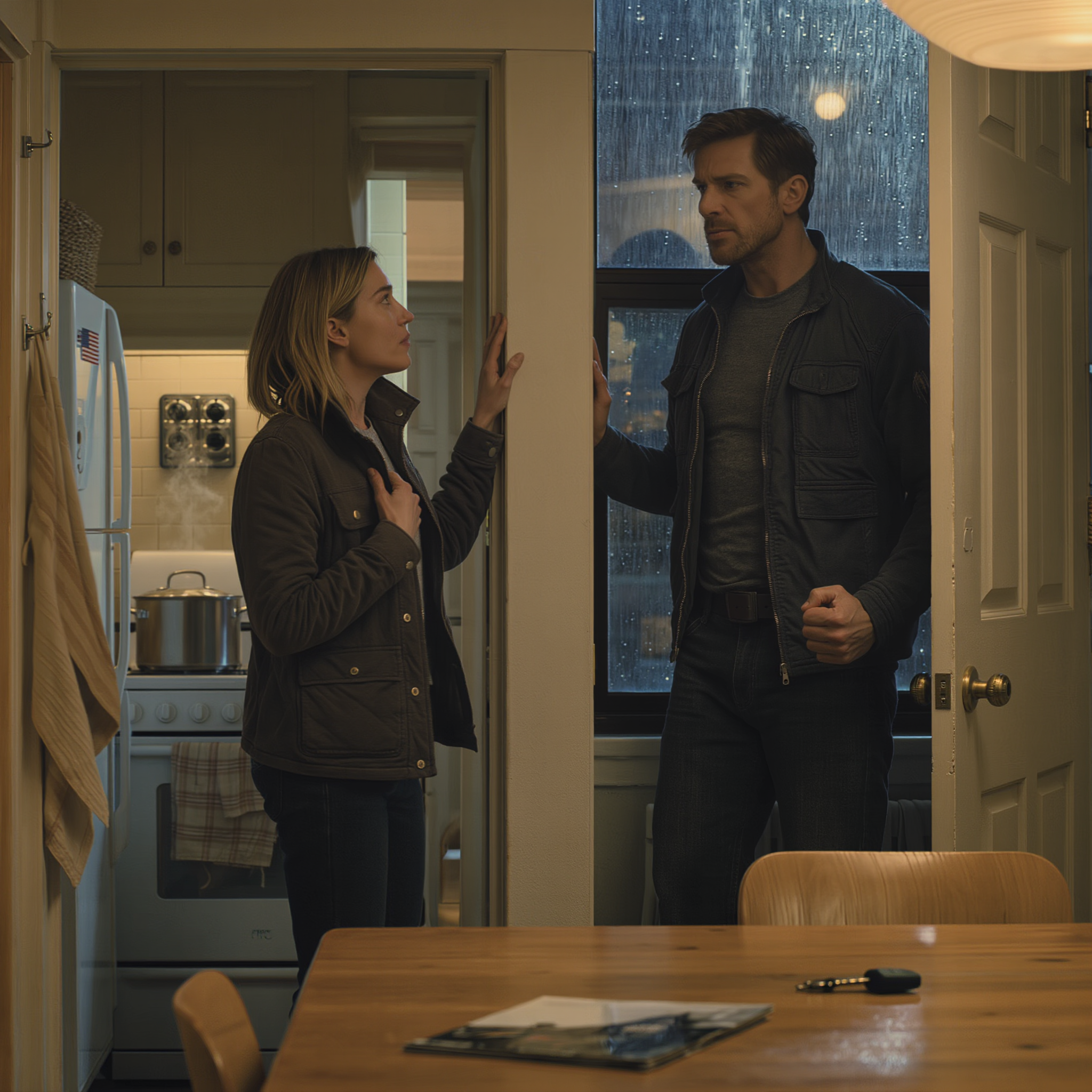
Masha woke at 6 a.m., just like every other day, when the city was still quiet and wrapped in mist. A faint blue light filtered into the bedroom, spilling across the floor, where her slippers sat waiting — neatly aligned, toes pointing outward, as if even they were ready to face another day.
She got up. Her back ached — a dull, familiar pain from the day before: eight straight hours at the salon, no break, no lunch, no time to breathe. She didn’t complain. She never did. Pain had long ago become part of the routine, like brushing her teeth or tying her apron.
She opened the curtains. The sky was a pale gray, not yet morning but no longer night. Below, the city began to stir: the low rumble of the garbage truck, the sleepy clang of a street vendor setting up her stand, the muted bark of a stray dog. Nothing dramatic. Just the world grinding into motion again.
In the kitchen, the refrigerator hummed softly. Masha moved silently, starting breakfast: oatmeal for Sonya, sandwiches for Kirill, and tea — always tea — for herself. Every motion was precise, practiced, automatic. Like a dance she’d memorized years ago and never been allowed to stop performing.
While waiting for the water to boil, her eyes drifted to the photo stuck to the fridge door. A family of three, taken on a beach in Anapa eight years ago. Kirill stood tall in the center, arms around Masha and Sonya. The sun was bright. Everyone was smiling. Masha stared at her own face in the photo — that wide, genuine smile. She couldn’t remember the last time it had felt that real.
These days, her smiles were mostly for others. For clients, for neighbors, for polite small talk. They never quite reached her eyes.
Behind her, the bedroom door creaked open. Heavy steps. Kirill.
He didn’t say “Good morning.” He hadn’t for years.
He walked into the kitchen in his usual way — like the apartment belonged to him and everything inside it was his by default, including her.
“Where’s my white shirt?” he asked gruffly, scratching his shoulder.
“In the closet,” Masha replied without turning around. “Right side. Second hanger.”
A pause.
“It’s not ironed.”
“I didn’t have time last night. I was home at ten.”
Another pause. Kirill opened the fridge and took out a yogurt. He peeled it open and leaned against the counter.
“You always have time for your clients. Not your family.”
The sentence floated in the air — not shouted, just dropped like a piece of trash he expected her to clean up.
Masha didn’t answer. She placed Sonya’s bowl on the table and moved to slice some bread. Her hands worked steadily, but something in her chest twitched. The same old script. The same old blame.
Kirill left the kitchen without a word.
Later that morning, while Sonya brushed her hair and Masha packed her lunch, Kirill called from the hallway.
“I’ll be late tonight.”
Masha looked up from the lunchbox. “Why?”
“Meeting with clients.”
That tone again — dismissive, unquestionable.
“Don’t forget it’s Sonya’s recital tonight,” Masha said.
“I said I’ll be late.”
And with that, the door closed. He was gone.
The salon was busy. Wednesdays usually were. Masha didn’t sit once between 10 a.m. and 6 p.m. She worked on nails, dyed hair, smiled, laughed when needed. Clients adored her — not just for her skill, but her warmth. At work, she was someone.
But by the time she got home, her legs throbbed. She climbed the stairs slowly, groceries in one hand, keys in the other. As she opened the door, the sound of the TV greeted her. Kirill, already home.
She blinked. “I thought you said you’d be late?”
“No meeting,” he said flatly. “Client canceled.”
No apology. No interest in how her day was. Just the back of his head facing the TV.
In the kitchen, Sonya’s drawing sat on the table. A bright splash of color: a house, a sun, a girl and her mother holding hands.
No father.
Masha touched the paper gently. Then she heard the sound — not loud, but sharp. Kirill’s voice, cold and low:
“Shut up! Masha, you’d better not make me angry, or you’ll get it! My mom and my sister need a car, and you’re going to buy it!”
The words hung in the air like smoke from a fire. Poisonous, acrid, suffocating.
Masha stood by the stove, her hand still holding the ladle. The soup simmered gently — rassolnik, dill and garlic filling the air. October rain trickled against the window. Outside, everything was the same. But inside her, something cracked.
Not burned. Not snapped.
Froze.
Something inside her — long buried, long silenced — turned to ice. And then, like frost creeping across glass, it began to spread.
She set the ladle down. Then she turned around.
She turned around slowly.
Her voice, when it came, was quiet — but there was something in it. Not fear. Not anger. Something harder. Like a blade wrapped in silk.
“What did you just say?”
Kirill didn’t even look up from his phone. He was slouched in the chair, one leg over the other, scrolling like nothing had happened.
“You heard me,” he said, chewing without chewing. “My mother’s been riding the bus for thirty years. Karina is pregnant — she needs transportation. You manage the money, so you’ll buy it.”
There it was. Flat. Decided. As if it were as obvious as picking up milk on the way home.
Masha blinked. Once. Twice.
And then she did something strange.
She smiled.
A tiny, crooked thing — not happy. Not amused. Just a kind of… wonder. The kind of smile people give when a long-unseen truth finally stares them in the face.
She looked down at her hands. Cream-stained fingertips, nails filed short — the hands of someone who works with care. Works constantly. Works for others. Always for others.
“What money, Kirill?” she said calmly. “The money I make at the salon? Sixty hours a week, aching legs, clients who treat me like their personal therapist while I buff their nails? You mean that money?”
Finally, he looked up. His eyes were cool. Distant.
“Ours,” he said. “We’re a family. Or did you forget that?”
Family.
The word echoed.
Seventeen years of marriage. Two children — Danya now off at university, Sonya in ninth grade. A mortgage she had paid, month after month, even during the years Kirill “changed jobs” and the salary arrived late. Her body had been worn thin between work and home. Her back hurt. Her hands cracked from chemicals. Her feet — size 37 — flattened from years of standing.
And this man, her husband, who hadn’t bought her flowers in seven years, who hadn’t asked her how she was in five — this man said: “You’ll buy the car.”
“I haven’t forgotten,” Masha said, turning the burner off beneath the soup. “I just can’t remember the last time your family asked me what I needed.”
That landed.
Kirill shifted.
He stood up. All six feet of him — broad-shouldered, suited, cologned. Once, his size had made her feel protected. Now, it was just one more thing he used to fill the room — to push the air out from her lungs.
“Here we go,” he muttered, walking to the window and lighting a cigarette — despite her asking, begging, not to smoke in the apartment. “Your grievances. Always the same. My mother’s elderly. Karina’s about to give birth—”
“Karina is twenty-eight and has a husband,” Masha interrupted, heat beginning to rise beneath her skin. “Let him buy her a car.”
“Don’t talk about my mother like that!”
And that… that was the moment.
She felt it like a shift in the earth beneath her feet — a quiet tectonic snap.
Not the words. The tone.
The way his voice cracked, like glass about to shatter. The way he stepped toward her, not quickly, but with something behind his eyes. A threat. Unspoken — but not imagined.
Masha untied her apron. Hung it neatly by the door.
“I’m going,” she said.
Kirill’s head whipped toward her.
“Where do you think you’re going?”
She was already putting on her jacket. Her hands trembled, but she zipped it up smoothly.
“Out. I need some air.”
“Masha.”
She didn’t turn around.
The door closed behind her with a firm click.
The stairwell was dark. Cold. She walked quickly, past the neighbor’s apartment where a baby was crying. Past the cracked tile. Past the smell of dust and old coats.
And then: the street. Wet. Alive. Breathing.
The rain had softened to a mist. Puddles reflected the orange glow of streetlights. Cars hissed as they passed, and the world seemed, for the first time in years, unfamiliar. And beautiful.
Masha walked.
She didn’t know where she was going. Just away.
She passed the grocery store where she always shopped on Fridays. Past the pharmacy. Past the bus stop where people stood in silence every morning, eyes glazed, bodies waiting.
The world, seen through mist, felt like a film she was no longer acting in — only watching now, as herself.
She stopped in front of a jewelry store. Behind the glass, gold shimmered under bright white lights. Bracelets, earrings, delicate rings. For a moment, she just stared.
When was the last time she had received a gift?
She remembered her last birthday. Kirill handed her an envelope with money and said, flatly:
“Buy whatever you want.”
She had bought Sonya sneakers. Danya a backpack.
Her phone buzzed. Kirill.
She silenced it. Didn’t even look at the screen.
She ended up at the mall.
It was bright, warm, noisy — the kind of place she used to rush through on errands. But now, she wandered. Slowly. As if her feet had forgotten what it meant to walk without a destination.
She bought a cappuccino on the third floor. Sat near the window. The city outside shimmered — all glass and light and distant thunder.
Her phone lit up again.
“Mother-in-law.”
She let it ring.
Then a message appeared:
Mashenka, Kirill told me everything. Why are you acting like this? You’re being childish. We are family. Karina really needs that car. The baby is coming soon…
The baby.
Her children had been her babies. Masha remembered long nights with fevers, sewing costumes for school plays, tutoring Danya in math until midnight. No one had offered her a car. Or even a “thank you.”
The cappuccino cooled.
And something inside her — something old and tired and worn — began to flicker.
A picture formed in her mind. Seventeen years. She had done everything right. Worked. Endured. Provided. Stayed quiet. Played nice.
And for what?
“Oh — I’m so sorry!”
A passing stranger had bumped her bag. It fell. Masha bent down, picked it up. Looked up and smiled automatically.
Automatically.
That word sat bitter on her tongue.
When was the last time I smiled and meant it?
She came home around ten.
The hallway light was off. The apartment was silent, but not in a peaceful way. More like a stillness before thunder.
She turned the key quietly, as if that would make a difference.
Kirill was in the living room.
The television was on, but the screen played to no one. He sat on the edge of the couch, waiting. He hadn’t even changed out of his work clothes. The knot in his tie was loosened, his jacket thrown over the armrest.
He didn’t look at her right away.
“Back at last,” he said, standing.
Masha froze at the threshold. Her shoes were wet from the rain. Her coat clung to her back. Her hair smelled like outside.
“Kirill,” she said softly. “I’m tired. Let’s talk tomorrow—”
“Tomorrow?” He stepped forward. His eyes were sharp, lips tight. “You made a fool out of me in front of my mother.”
Masha blinked. “What?”
“She called me crying,” he snapped. “Said you were rude. You dismissed her. You ignored her messages.”
Masha took off her shoes, slowly. Her feet ached. Her back was screaming. Her arms were shaking, not from fear — from exhaustion.
“I didn’t speak to her today,” she said, placing her shoes neatly by the wall. “I didn’t answer her message, that’s all.”
“Exactly. You rejected her. She reached out, she tried to be kind—”
“Kind?” Masha looked up. “Asking me to buy her a car is kindness?”
“She didn’t ask. I did,” Kirill said, voice rising. “Because I know what this family needs. You’re just being petty and selfish.”
Something inside her shifted again. Not ice this time — heat. A slow burn crawling up her spine.
“Selfish,” she echoed. “You think I’m selfish?”
“You are! Always whining about work, pretending you’re some kind of martyr. You work in a beauty salon, for God’s sake — not a coal mine!”
That was it.
The thread snapped.
She stepped into the room, hands trembling with fury.
“Do you have any idea what it’s like to be on your feet for ten hours? To smile at rude clients who treat you like a servant? To come home and still be expected to cook, clean, raise children, manage bills — while you sit in this damn chair and scroll your phone like a king?”
“Watch your tone,” he growled.
“Or what?” Her voice rose. “You’ll hit me?”
Kirill’s face twisted. “Don’t be dramatic.”
“No, let’s talk,” she spat. “Let’s talk about how for seventeen years, I’ve kept this family afloat. Paid half the mortgage. Bought groceries. Paid for the kids’ tutors. And now you want me to take out a loan to buy a car — not for us, not for our kids — but for your mother and your sister?”
“They’re family! You’re my wife! You’re obligated—”
“No,” Masha said. Her voice was calm now. Cold. “I’m not. I’m not obligated to fund your mother’s lifestyle. I’m not obligated to smile through your arrogance. And I’m not obligated to stay in a marriage where the only thing expected of me is silence.”
Kirill’s face flushed deep red. He stepped forward. Towered over her.
“Don’t push me, Masha.”
“Don’t threaten me, Kirill.”
And then, he snapped.
His hands gripped her shoulders — not a push, not quite — but enough to shake her.
“You will take that loan,” he hissed. “You’ll work extra shifts if you have to. My mother has sacrificed for this family—”
“And what have I done?!” she shouted. “What have I sacrificed, Kirill? My youth? My health? My dreams? You think I wanted to spend my life rubbing cuticles and scrubbing dishes?”
“You’re being irrational. Emotional—”
“I’m being done,” she said.
He stared at her, stunned.
Then, slowly, his face hardened.
“Fine. You want a fight? Here’s the deal: you either go to the bank tomorrow and take out that loan… or we’re getting divorced.”
The word fell like a brick.
Silence. A long one.
Masha stared at him. She didn’t speak. Not for a long time.
Then she walked into the bedroom.
“What are you doing?” he called after her.
She didn’t answer. She opened the closet. Pulled out a small suitcase.
“Masha.”
“I’m leaving,” she said, folding clothes with steady hands. “For a few days. To think.”
“Don’t be ridiculous.”
“I’ve been ridiculous for seventeen years,” she replied.
“Where will you go? You don’t have anyone.”
“I’ll find a place. A hotel. A bench. Anything is better than this.”
“You can’t afford a hotel on your pathetic paycheck.”
She zipped the bag shut.
“I’ve paid for more than you think. Including that suit you wear to work.”
At the door, she turned back.
“And the apartment?” she added, voice steady. “It’s not just yours. I have every receipt, every transfer. You want a divorce? Fine. But don’t expect to walk away with everything.”
“You’re bluffing.”
“Try me.”
And then, from down the hall, a soft sound.
Sonya.
The door creaked open. Her face pale. Eyes glassy.
“Mom?” she whispered.
“It’s okay, sweetheart,” Masha said quickly. “Go back to bed.”
“Nothing is okay!” Kirill barked. “Come here, Sonya. See what kind of mother you have—selfish, cold—”
Masha turned. Lightning-fast.
“Don’t you dare,” she said, stepping between him and their daughter. “Don’t you ever bring the children into this.”
Sonya shut her door. Seconds later, the sound of music — loud, desperate — filled the hallway.
Kirill stood still. Breathing hard.
Masha looked him straight in the eyes.
“I’m not taking out a loan,” she said clearly. “Not now. Not ever.”
“Then pack your things,” he spat. “Because this marriage is over.”
“Good,” she said.
And then she left.
She walked down the stairs into the night.
For the first time in years, she didn’t feel numb. Or small. Or erased.
She felt terrified. Completely, utterly terrified. But more than anything… She felt free.
Masha spent her first night at a cheap business hotel near the metro station. The walls were thin, the bed was stiff, and the air smelled faintly of bleach. But when she lay down — fully clothed, staring at the ceiling — she felt something unfamiliar:
Peace.
Not comfort. Not relief. But peace — the kind that comes from finally choosing yourself.
The next morning, she didn’t cry.
She didn’t call anyone.
She made a list.
Step One: Find a Lawyer
The woman came recommended by a client — a regular at the salon with a tight bob and a colder stare than Masha had ever mastered.
“Divorce lawyer?” the woman had said, casually, while drying her nails. “You want Natalya Petrovna. She eats men like your husband for breakfast.”
Masha found her office tucked behind a bank — no sign, no fuss. The receptionist looked up as she entered, and when Masha said her name, the door opened.
Natalya Petrovna stood at the window, arms crossed, silver hair in a chignon so tight it could cut glass.
“Tell me everything,” she said. No pleasantries. No small talk.
And so Masha did.
She told her about the years. The work. The mortgage. The children. The family that only took. The day Kirill said she was “obligated.”
Natalya listened without a single interruption.
When Masha finished, her throat dry, her hands clenched, the lawyer said just one thing:
“Do you have documentation?”
Masha opened her bag and laid out her life.
Receipts. Bank statements. Mortgage payments. Bills. Screenshots of transfers. She’d kept everything. Every ruble, every contribution. Seventeen years of partnership, in black and white.
Natalya smiled — the kind of smile that didn’t warm a room, but lit a fuse.
“Good girl,” she said. “We’re going to war.”
Step Two: Tell the Kids
Danya came home from university that weekend. Sonya had already been quiet, withdrawn, watching everything with wide eyes. Masha knew she couldn’t keep them in the dark.
So she sat them down.
Not as victims. Not as children.
As people who deserved the truth.
“Your father and I are separating,” she said. “It’s not sudden. It’s not a fight. It’s been building for a long time. I stayed quiet to keep peace. But peace isn’t real if only one person is sacrificing for it.”
Sonya cried. Danya didn’t. But he asked questions — serious, thoughtful ones. About the apartment. About custody. About their future.
“Are you okay, Mom?” he asked, finally.
Masha took his hand. It was large now — when had that happened? When had her boy become a man?
“I’m not okay,” she said. “But I’m getting okay.”
And somehow, that made him smile.
Step Three: Court
The trial took three months.
Kirill arrived in a tailored suit and practiced outrage. He told the judge Masha had “abandoned the family,” “refused to contribute,” “poisoned the children against him.”
He brought his mother to the stand.
She wept. Claimed Masha was lazy. That she never worked. That she sat at home “painting nails” while her husband slaved for them all.
Masha said nothing.
Her lawyer did.
Natalya laid the documents out like a sword.
Every payment. Every grocery bill. Every transfer. The numbers were simple. Unemotional. Devastating.
The judge — a gray-haired man with weary eyes — looked over the files. Then at Kirill.
“Do you have anything to refute this?” he asked.
Kirill opened his mouth. Closed it.
His mother crossed her arms.
The ruling was clear:
The apartment would be sold and split.
Child custody would go to Masha.
Kirill would pay support — nothing extravagant, but enough to note his obligation.
When the judge struck the gavel, Masha didn’t cheer. Didn’t cry.
She just breathed.
Step Four: Let Go
Kirill tried to bargain after that. He called her late one night, angry.
“We could’ve fixed this.”
Masha didn’t answer.
“You’ve destroyed our family.”
She exhaled slowly.
“I didn’t destroy anything. I just stopped pretending it wasn’t already broken.”
A week later, he left Moscow.
Took a job “up north,” as he said — some oil gig, double pay, triple ego.
He sent a final message:
“The kids will come crawling back to me when they realize you’ve turned them against me.”
She didn’t reply.
A week after that, his mother and sister followed him — baby and all. Before leaving, his mother called her one last time.
“Because of you, my son is living in the middle of nowhere!”
Masha laughed, softly.
“Because of you, he grew up thinking the world owes him a woman’s labor. Enjoy the cold.”
She hung up.
And never picked up again.
Masha used her half of the apartment money to buy a modest two-room flat in the same neighborhood. Sonya decorated her room with fairy lights and photos of her favorite band. Danya visited on weekends, bringing stories and jokes and, once, a girl named Yulia — bright-eyed, shy, respectful.
“Mom, meet Yulia.”
Masha watched how her son looked at the girl — not like something to possess, but someone to stand beside.
She had done something right after all.
One evening, while cleaning, Masha found a small envelope at the back of a drawer. Inside was a photo — the beach, that day in Anapa, Kirill’s arm around her, Sonya clinging to her skirt.
She looked at her own face.
That smile.
She didn’t recognize it anymore.
She didn’t miss it, either.
She placed the photo in a box marked “Past” and closed the lid.
The new apartment was small.
Two rooms, old tile in the hallway, paint that peeled near the windows. The balcony door stuck when it rained. The sink gurgled. There was a strange stain on the ceiling that no one could quite explain.
And Masha loved it.
It was hers.
The first night, she sat cross-legged on the floor with Sonya, eating fast food straight from the paper bags. The couch hadn’t arrived yet. The fridge was empty except for bottled water and yogurt. They ate, laughed, and watched a cooking show on her phone balanced on a coffee mug.
“We need curtains,” Sonya said, looking up at the naked windows.
“We need a lot of things,” Masha smiled. “But we have each other.”
Sonya grinned and leaned against her mother’s shoulder.
“Can we paint the walls green?”
“You can paint your room whatever color you want.”
It was such a simple sentence.
But it held so much.
No one had ever told Masha that before.
Now, she was saying it to her daughter — like passing a torch that had never been handed to her.
The Salon
Masha returned to the salon the following week. She didn’t expect much — just normalcy. But something had shifted.
Clients who had heard “rumors” came in with hugs, with sympathy, with admiration.
“You’re so brave,” one whispered.
“I could never do that,” another said. “I wish I had your courage.”
Masha didn’t feel brave.
She felt… honest.
She started taking on apprentices. Two girls from the local technical college who were learning the trade — bright-eyed, nervous, hopeful. Masha saw herself in them — but younger. Less afraid.
She taught them how to paint clean cuticles, yes. But also how to speak to clients. How to stand up for themselves. How to charge what they’re worth.
“Don’t give discounts to people who treat you like a servant,” she said one day.
“They’re not paying for your time. They’re paying for your talent.”
The girls looked at her like she was someone.
Maybe she was.
Little Joys
She started buying herself flowers.
Not every day. But sometimes.
A small bunch of daisies from the corner kiosk. A single sunflower. Tulips in spring.
She hung pictures — bright, strange, abstract ones. Cooked with real spices again. Rediscovered music. Played old CDs from her teenage years while mopping the floor.
One Sunday, she walked past a bookstore.
She paused at the entrance. She hadn’t bought a book for herself in years. Always rushing. Always practical.
But something pulled her in.
She wandered the aisles like a tourist in a forgotten country.
And then, near the back, she found it — a slim volume of poetry. No famous name. No flashy cover.
She opened to a random page.
“I thought this was called living,”
“It turned out it was called enduring.”
Her knees nearly gave out.
She bought the book. Took it home. Read it in bed with tea and the window cracked open. Spring air drifted in. Somewhere below, a neighbor was playing violin. Not well. But not terribly either.
She cried — not with pain.
But with recognition.
The Message
It came at 10:46 p.m. on a Tuesday.
From Kirill.
“Masha. I was wrong. Can we talk?”
Just that.
She stared at the screen for a long time. Not with anger. Not even with sadness. Just a quiet sense of detachment — like watching someone knock on the wrong door, long after the lights were off.
She didn’t respond.
She deleted the message.
Then she turned off her phone, went to the kitchen, and opened the window. The breeze was warm. The curtains fluttered like something alive. She leaned out, breathing deep.
The night didn’t feel heavy anymore.
It felt infinite.
The Question
A few days later, Sonya was sitting at the table, sketching in her notebook. She glanced up, casually, and asked:
“Mom, are you happy now?”
Masha paused. Not because she didn’t know — but because the question deserved more than a yes or no.
She looked around.
The living room was still half-furnished.
The hallway needed new paint.
The washing machine made a strange noise when it ran.
She had no husband.
No backup.
No vacations planned.
No luxury.
But…
She could hang any painting she liked.
She could sing while cooking.
She could say “no” and mean it.
She could smile — and know that it wasn’t automatic.
“You know, sweetheart,” she said slowly, pulling Sonya close, “I’m not sure if I’m happy.”
Sonya looked worried.
“But I know one thing for certain,” Masha continued. “I’m finally living. For real.”
Sonya smiled, rested her head on her shoulder.
And outside, the lilacs were blooming.
Six months passed.
Spring leaned into early summer, and Masha’s apartment slowly became a home — not just a place to sleep, but a space that carried her voice, her scent, her laughter. The walls were painted soft white with touches of sage green in the kitchen. A crooked little plant leaned toward the window like it, too, had found a reason to grow.
The living room had mismatched chairs, secondhand bookshelves, and a rug Sonya picked out “because it felt like walking on a cloud.” It wasn’t perfect. It wasn’t elegant.
But it was theirs.
One Saturday morning, Masha stood by the window with her coffee — the same way she always had, but it felt different now.
The street below was alive with sunlight. Children played in the courtyard, shouting and laughing. Someone was grilling meat nearby; the smell floated up, mingling with lilac and warm asphalt.
Behind her, the apartment hummed gently with life. The kettle still warm. The washing machine humming its strange, familiar rhythm. The smell of baked apples drifting in from the oven.
And then:
“Mom, come meet Yulia!”
Danya’s voice from the hallway.
He’d come for the weekend, as promised, this time bringing someone new.
Masha turned around — and there she was.
Yulia. A slight, serious-eyed girl with a quiet confidence and a shy smile.
She shook Masha’s hand.
“I’ve heard so much about you,” Yulia said. “Your son really admires you.”
Masha looked over at Danya. He didn’t flinch, didn’t roll his eyes, didn’t act embarrassed. He just smiled — with pride.
In that moment, Masha realized:
He hadn’t just brought a girl home.
He had brought someone into her world — and that meant something.
That night, after they’d eaten apple cake and played cards at the kitchen table, after the dishes were stacked and laughter still lingered in the air, Sonya leaned against the doorway, her arms crossed.
“Mom,” she said, “you know what’s kind of amazing?”
“What?”
“You look younger now.”
Masha blinked. “I do?”
“Yeah. Not like… younger-younger. Just… lighter. Like you finally exhaled.”
Masha didn’t know what to say.
So she just smiled.
And this time, it wasn’t automatic.
One Last Knock
The message came weeks later. A letter, not a text. Actual paper. Written in Kirill’s messy, slanted handwriting.
She almost didn’t open it.
But curiosity tugged.
Masha,
I’m sorry. Truly. I thought you’d never leave, so I never had to change. I was wrong. The apartment is cold without you. The town is cold without you. Life is cold without you.
If there’s any chance — even the smallest — that you’d consider talking… please write back. Not for me. For us.
Masha read it once. Then again.
Then folded it neatly and placed it in a box labeled “Past.”
She did not cry.
She did not rage.
She simply placed it beside old photos and old letters — where it belonged.
A Final Scene
A few days later, Masha returned to the bookstore.
The poetry section. Same corner.
She wasn’t looking for anything in particular — just wandering.
Her fingers traced the spines of books she hadn’t read, hadn’t had time to read for years. Time. She had time now. Not a lot. But enough.
She found a new volume by the same poet — thin, delicate, quiet.
She flipped it open.
“The body learns how to carry weight silently.”
“But one day, it learns how to let go.”
She smiled.
Took the book home. Placed it next to the first one, on her nightstand. A small shrine to everything she had endured — and everything she had refused to continue enduring.
That night, after Sonya went to bed and the apartment settled into its gentle rhythm of night sounds — creaking pipes, humming fridge, soft wind at the window — Masha stood once more by the window with her tea.
She looked at the city below.
And then at her own reflection in the glass.
This was her face now.
Not the face of someone who’d been rescued.
But someone who had rescued herself.
Somewhere, behind her, her phone buzzed. A message.
She didn’t rush to check it.
There was no urgency anymore.
Nothing chasing her.
She sipped her tea.
And smiled.
Because this moment — this quiet, ordinary moment — belonged to her.
Not as someone’s wife.
Not as someone’s daughter-in-law.
Not as someone’s mother.
But simply as Masha.
And that… That was the real miracle.
News

My mom texted, ‘We changed all the locks. From now on, you don’t have a place in this house anymore. Let’s see how brave you are now, haha.’ Two days later, their attorney emailed, ‘We have a problem. Please call back immediately.’ She locked me out and told me I had no home… so I claimed the part of the house I’d already paid into.
My name is Leo. I’m thirty‑two years old, born and raised in the Pacific Northwest. Last week, my own mother…

Twenty suitcases appeared at the gate of my house by the lake, as if someone had turned it into a check-in point for a whole month. A few minutes later, my parents showed up with a bunch of relatives – and since I didn’t want to clean up their mess, my mother said, ‘The family has the right!’ I didn’t argue. I just pointed to the sign: Guests Only. Then the building manager started reading names… and stopped at my father’s name. The atmosphere changed so quickly that my mother grabbed my hand and whispered, ‘Don’t do that.’
The first thing I saw wasn’t my parents’ car. It was the suitcases. Twenty of them, lined up like a…

On my birthday, my grandmother gifted me a $36 million hotel as if it were nothing. Hours later, my mother showed up with her new husband and insisted that we ‘manage it together as a family.’ I said, ‘Absolutely not. It’s mine.’ My mother didn’t bat an eye’she just pointed to the door and told me to pack my bags and leave. That’s when my grandmother stepped in and revealed the only thing she’d kept secret… and the smile on my mother’s new husband’s face not only disappeared, but completely disappeared.
On my 22nd birthday, my grandmother looked me dead in the eye across a white tablecloth and said, “For your…

My boyfriend embarrassed me in front of his friends, then walked out of the restaurant and left me with the entire check. As he disappeared into the crowd, he said loud enough for everyone to hear, ‘A girl like you should be grateful I ever dated you.’ I didn’t cry. I smiled… and waited. This morning, my phone wouldn’t stop ringing 13 missed calls from the same number that blocked me just days ago.
My boyfriend called me ugly in front of his friends and dumped me at a restaurant, leaving me to pay…

Three years after my husband was gone, his family acted like my child and I had never existed. I ended up at the bus station with two bags, counting coins for a ticket when his sister pulled up in a luxury SUV I’d never seen before, stepped out in high heels, and stared at me like she’d been searching for days. No sorry. Just one cold sentence as she opened the door: ‘Get in. You need to hear what really happened.’
The thunder rumbled outside the window as if tearing the quiet night to pieces, and it tore my already broken…

At the restaurant, my brother clinked his glass and said, ‘To family everyone except Liam. He’s adopted.’ Everyone laughed. Then the server set the black folder in front of me: $3,270 for the whole table. I slid it back and said, ‘Put it under my brother’s name he made the reservation.’ His smile vanished… and then the manager walked over.
I’m Liam, 28, and for as long as I can remember, I’ve been the family’s emotional punching bag—with a polite…
End of content
No more pages to load