My son-in-law forced me to sell my house and threw me out into the freezing Chicago winter. Then my own daughter threw a broken garbage bag at my chest and shouted, “Take your trash and get out.” I stood there humiliated while the neighbors watched from their windows.
But when I finally opened that bag inside a cheap motel room later that night, I was truly amazed. Inside, I found a savings account with $700,000 and a secret note. What was written inside that note left me shocked and changed everything I thought I knew about my family.
Before I tell you what was in that bag and how I got my revenge, please hit the like button if you believe families should treat each other with respect. Subscribe to the channel so you do not miss the next part of my story, and tell me in the comments where you are watching this video from. It makes this old man very happy to know I have friends listening from all over the world.
My name is Harold Bennett, but everyone calls me Hal. I am 75 years old, and I have lived in the suburbs of Chicago my entire life. I worked as a general contractor for 45 years, building homes for other families while saving every penny to build a life for my own.
I thought I had done everything right. I worked hard. I paid my taxes, and I raised my daughter Emily to be a good person.
But standing there on that driveway with the November sleet hitting my face, I realized that somewhere along the line, I must have made a terrible mistake.
It started ten minutes earlier.
The sound of my vintage leather suitcase hitting the wet pavement echoed like a gunshot in the quiet cul-de-sac. That suitcase had traveled with me for forty years. It had been to Florida for family vacations and to the hospital when my wife Martha passed away two years ago.
Now it was lying face down in a puddle of freezing slush in the driveway of the house I built with my own two hands.
Greg Pearson stood in the doorway, blocking the warmth coming from inside.
My son-in-law was wearing a cashmere sweater that probably cost more than my monthly Social Security check, and his face was twisted into a sneer that made my stomach turn. He looked at me like I was a stain on his expensive rug, not the man who had welcomed him into the family ten years ago.
“You are out of time, Harold,” Greg said, his voice cold and devoid of any emotion. “The bank is coming on Monday. This house has been foreclosed on. You need to leave before the sheriff comes to drag you out.”
Foreclosed.
The word hit me harder than the cold wind.
That house in Naperville was my pride and joy. It was a four-bedroom colonial with a wraparound porch that I laid the foundation for myself back in 1985.
When Martha died three years ago, I was lost in grief. Greg had come to me with papers talking about tax optimization and asset management. He said he was a real estate genius and that he would take care of the burden of ownership so I could just enjoy my retirement.
I trusted him.
I signed the papers.
I thought I was signing over management rights, but evidently I had signed away my life.
I swallowed my pride. It tasted like bile in the back of my throat. My hands were shaking partly from the cold and partly from the sheer terror of being homeless at 75.
“Greg, please,” I said, my voice cracking. “It is twenty degrees out here. It is going to snow tonight. Just let me stay in the garage. I will leave in the morning. I just need one night to figure things out.”
Greg laughed. It was a dry, cruel sound.
“There is no garage for you anymore, Harold. You are a liability. We cannot have you hanging around when the appraisers come. You are bad for property value.”
He checked his gold watch as if I was boring him, as if destroying a man’s life was just a tedious appointment in his busy schedule.
I looked past him into the hallway, hoping to see Emily—my daughter, my little girl. She was the one person in this world who was supposed to love me unconditionally. I had paid for her college. I had walked her down the aisle. When Greg started his real estate business, I was the one who gave them the seed money.
Then I saw her.
Emily stepped out from the kitchen into the hallway. She was wearing a heavy coat and her face was pale. For a second, I felt a wave of relief wash over me. I thought she was coming to stop this madness. I thought she was going to tell Greg to step aside and let her father back into his home.
“Emily,” I called out, taking a step toward the porch. “Honey, please talk to him.”
She did not look at Greg. She looked straight at me, and her eyes were wide and wild.
In her hands, she was clutching a large black heavy-duty trash bag. It looked full and heavy, and there was a rip in the side where some gray fabric was poking out. She walked past Greg and stood on the edge of the porch.
The steps I had sanded and stained myself were slippery with ice. She looked down at me, and for a moment I saw something in her eyes that looked like tears.
But then her expression hardened into a mask of pure fury.
“Take your trash,” she screamed.
Her voice was so loud it caused a dog to bark two houses down. She hauled the bag back and threw it with all her strength.
It was heavy.
It hit me square in the chest, knocking the wind out of me. I stumbled back, my heels catching on the wet pavement, and I nearly fell. I caught the bag, instinctively clutching it to my chest to keep my balance.
It smelled old and dusty like the attic.
“Take your garbage and get out,” she yelled again, her voice breaking into a shriek. “Don’t you ever come back here. Don’t call us. Don’t write to us. Just disappear, Harold. Get out of our lives.”
The silence that followed was deafening. The only sound was the wet slap of the sleet hitting the asphalt and the heavy breathing of my own chest.
I looked at her, stunned.
This was the girl I used to read bedtime stories to. This was the woman who held my hand at her mother’s funeral and promised we would take care of each other.
Now she was looking at me with what looked like pure hatred.
Greg put his arm around her shoulders, smirking.
“You heard her, Harold. Get lost.”
He slammed the front door shut. The sound was final. The deadbolt clicked into place. Then the porch light flickered and went out, leaving me standing in the gray gloom of a winter afternoon.
I stood there for a long time.
The cold was seeping through my thin jacket, settling into my bones. My knees, which had been bothering me for years, started to throb.
I looked down at the trash bag in my arms. Through the rip in the side, I could see the fabric of one of Martha’s old gardening shirts. It was covered in dirt.
They had thrown my wife’s clothes at me.
They had packed up the memories of her and thrown them at me like refuse.
I looked up at the house next door. Mrs. Higgins was watching through her blinds. She had lived next to us for twenty years. She knew me. She knew Martha.
But she didn’t come out.
She let the blinds snap shut, turning her back on the spectacle.
I felt a shame so deep it burned hotter than the cold.
I was a man who had built a life on dignity. I paid my bills on time. I held doors open for strangers. I tipped the waitress even when the coffee was cold.
And now I was a 75-year-old man standing in the rain with a trash bag and a suitcase kicked to the curb by his own flesh and blood.
I bent down, my joints creaking in protest, and picked up the handle of my wet suitcase. It was heavy, but the burden in my heart was heavier.
I adjusted the trash bag under my other arm.
I should have left it there. I should have left the trash on their lawn as a final statement. But seeing Martha’s old shirt poking out, I couldn’t do it. I couldn’t leave her things in the mud, even if my daughter had discarded them.
I turned around and started walking down the driveway.
Every step was a struggle.
The icy slush soaked through my shoes, instantly numbing my toes. I walked past the mailbox I had installed last summer. I walked past the oak tree I had planted when Emily was five years old.
I remembered holding her up so she could touch the lowest branch.
Now that tree towered over the street, its bare branches scratching at the gray sky.
I reached the sidewalk and turned left toward Washington Street. The wind picked up, blowing snow into my eyes. I kept my head down. I didn’t want anyone to see me. I didn’t want anyone to recognize Hal, the contractor, looking like a vagrant.
My mind was racing, trying to make sense of what had just happened.
How could Greg have foreclosed on the house? It was paid off. I had paid the mortgage off ten years ago. The house was worth $850,000 in today’s market.
Where did the money go?
And Emily… my sweet Emily. How could she stand there and watch him do this? How could she throw this bag at me with such venom?
I walked for what felt like miles, but was probably only ten blocks. My destination was the bus stop near the old strip mall.
My car was gone.
Greg had sold it two weeks ago, claiming the transmission was shot and it wasn’t worth fixing. He said he would buy me a new one, but that never happened.
Another lie in a long list of lies I was just now beginning to see.
I finally reached the bus shelter.
It was a plexiglass box covered in graffiti that offered little protection from the wind. I collapsed onto the metal bench, my chest heaving. I was shivering violently now.
I set the trash bag down on the wet concrete next to me. I looked at it with disgust.
My daughter had called me trash. She had thrown this at me to hurt me, to humiliate me.
I reached into my back pocket and pulled out my wallet. My hands were shaking so badly I could barely open it.
I needed to know what I had.
I needed to take stock of my life.
I counted the bills.
Two twenties and two ones.
$42.
That was it.
That was my entire net worth.
I had worked for fifty years. I had built schools and churches and homes. I had saved hundreds of thousands of dollars for retirement.
And now I had $42 and a bag of old clothes.
I checked my bank app on my phone with freezing fingers.
Account frozen. Contact branch.
The message stared back at me in bright red letters.
Greg must have done something. He had power of attorney. He had access to everything.
A tear, hot and angry, rolled down my cheek. I wiped it away quickly.
I wouldn’t cry.
Not here.
Not where people could see.
A bus pulled up, its brakes screeching. It wasn’t going anywhere in particular, just heading west—away from the expensive neighborhoods, away from my past.
The driver opened his door and looked at me with tired eyes.
“You getting on, Pops?” he asked.
I nodded and grabbed my suitcase and the trash bag.
I hauled them up the steps, my body screaming in protest. I fed two of my precious dollar bills into the machine.
“Where to?” the driver asked.
“Away,” I whispered. “Just away from here.”
I moved to the back of the bus and sat down, hugging the trash bag to my chest for warmth.
The bus lurched forward, leaving Naperville behind.
I looked out the window, watching the familiar streets blur into the gray afternoon.
I didn’t know where I was going to sleep tonight.
I didn’t know how I was going to eat tomorrow.
All I knew was that my life as I knew it was over.
But as I clutched that plastic bag, feeling the lumpy shape of the old clothes inside, I had no idea that my life was actually just beginning.
I had no idea that the bag my daughter threw at me wasn’t an insult.
It was a lifeline.
If you want to know what I found inside that bag when I finally got to safety, hit that subscribe button right now. You are not going to believe what my wife Martha had done years ago to protect me from this exact moment.
The payoff is coming, and trust me—Greg is going to wish he had never opened that door.
Let’s keep going.
I got off the bus three miles down the road at a place called the Sleepy Traveler Motel. It was one of those places where the neon sign hummed loudly and the letter M was burned out, leaving it reading HOTEL.
The paint was peeling off the exterior walls and there were two rusted pickup trucks in the parking lot. It was not the kind of place a man like me usually stayed, but beggars could not be choosers.
I walked into the lobby, which smelled of stale coffee and industrial cleaner. The clerk was a young man with headphones around his neck who barely looked up from his phone.
I asked for a room for the night.
He told me it was $39 plus tax.
I counted out my bills on the scratched countertop. Two twenties and two ones. I had $42 to my name. After paying him, I was left with less than a dollar in my pocket.
He handed me a physical key attached to a green plastic diamond and pointed toward the back of the lot.
“Room 104.”
I walked through the sleet to the room. The door stuck and I had to put my shoulder into it to get it open.
Inside, it was freezing.
The heater under the window rattled and wheezed, but pushed out only lukewarm air. The carpet was a suspicious shade of brown and the bedspread looked like it had not been washed in a decade.
But it was dry.
And it was out of the wind.
I dropped my suitcase on the floor and sat on the edge of the mattress. My knees popped and ached.
I stared at the black trash bag I was still clutching in my left hand.
I hated that bag.
It was a symbol of my humiliation. My daughter Emily had thrown it at me like I was nothing, like I was the garbage.
I felt a surge of anger rise in my chest. I wanted to open the door and hurl the bag into the dumpster outside.
I did not want her pity trash.
I did not want her castoffs.
I stood up and grabbed the plastic knot, intending to do exactly that.
But as I lifted it, the weight surprised me again.
It was heavy—heavier than old clothes should be.
And then the cold hit me. The motel room was barely fifty degrees. I was shivering in my thin jacket.
My pride was screaming at me to throw it away, but my survival instinct was whispering that I needed warmth.
If there was a sweater in there or a coat, I needed it.
I sat back down and untied the knot.
The plastic tore easily.
I reached in and pulled out the first item.
It was a wool cardigan.
I froze.
It was gray with pearl buttons.
It belonged to Martha, my late wife.
I brought it to my face and inhaled.
It still smelled faintly of lavender and the potting soil she used in her garden.
I pulled out another item: a pair of gardening trousers stained at the knees, then a flannel shirt she used to wear on Sunday mornings.
My throat tightened.
Emily had not just thrown random clothes at me.
She had thrown her mother’s clothes.
Why would she do that?
Why would she be so cruel as to taunt me with the memory of the woman we both loved?
I dug deeper, looking for something that might fit me.
The bag was packed tight.
As I reached the bottom, my fingers brushed against something hard and rectangular.
It was not fabric.
It felt like cardboard, but it was rigid.
I pushed the clothes aside and peered into the bottom of the sack.
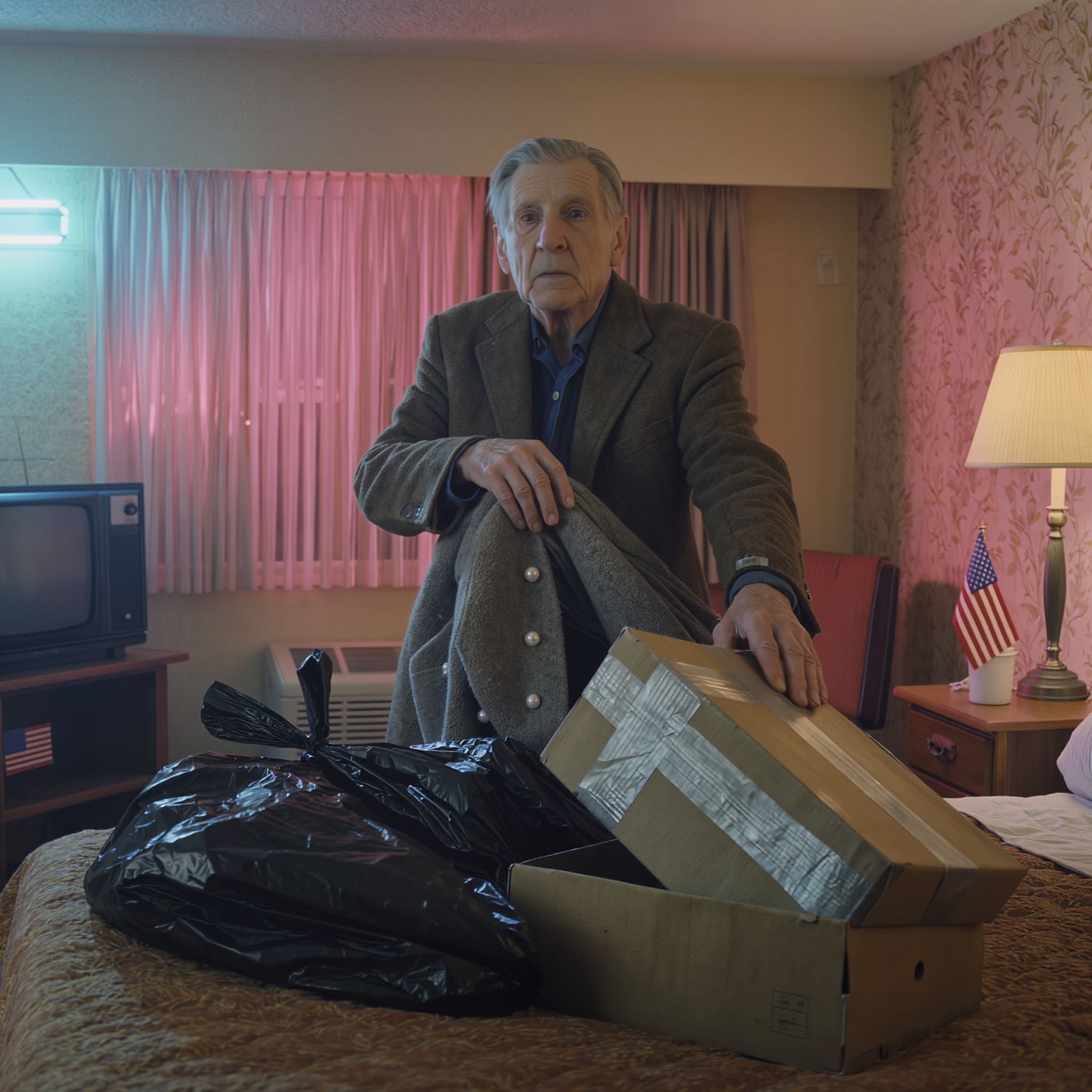
Taped securely to the bottom of the bag with layers of silver duct tape was a shoe box. It looked like an old box for work boots—battered and worn.
I frowned.
Why would Emily tape a shoe box to the bottom of a trash bag full of her dead mother’s clothes?
I reached in and tried to pull it out, but the tape was thick. I had to use my fingernails to peel back the edges, fighting with the adhesive.
It took me five minutes of struggling—my breath misting in the cold air—before I finally ripped the box free.
I set the box on the bedspread.
It was heavy.
I peeled off the remaining tape that held the lid down. My heart was beating a little faster now, though I did not know why. Maybe it was just curiosity. Maybe it was the strange feeling that I was missing something important.
I lifted the lid.
The first thing I saw was money.
Stacks of it.
Not neat bank-wrapped stacks, but bundles of bills held together with rubber bands. Tens, twenties, fifties—old bills, worn bills. The kind of money you get from garage sales or selling things for cash.
I stared at it, my mouth hanging open.
I reached out and touched a stack of twenties.
It was real.
I quickly counted one bundle.
$500.
There were dozens of bundles.
I did a quick mental calculation.
There had to be at least $20,000 here in loose cash.
My hands started to shake uncontrollably.
Where did Emily get this?
Why did she give it to me?
And why did she throw it at me in a trash bag while screaming at me to get out?
I set the cash aside on the bed.
Underneath the money was a small blue book.
I recognized it immediately.
It was a passbook savings account, the kind banks hardly used anymore.
I opened it.
The name on the account was Harold Bennett.
My name.
But I had never opened an account at the Delaware Trust Bank.
I flipped to the last entry.
The date was three years ago, just a week before Martha died.
The final balance was $700,000.
I gasped aloud, the sound echoing in the empty room.
$700,000.
I sat there staring at the numbers, unable to comprehend what I was seeing.
$700,000.
Plus the $20,000 in cash on the bed.
This was a fortune.
This was more money than I had ever seen in one place.
Flashbacks hit me like physical blows.
I remembered Martha sitting at the kitchen table late at night, selling her antique finds on the internet. I remembered her telling me she was putting a little aside for a rainy day.
I remembered her warning me about Greg.
She never liked him. She always said his smile did not reach his eyes.
“Hal, you have to be careful with him,” she had said to me a month before she passed. “He is a shark, Hal. Do not let him near the deed to the house.”
I had dismissed her worries. I told her Greg was family. I told her he was a businessman.
Then I remembered three years ago, sitting in the study with Greg. He had poured me a glass of expensive scotch. The papers were spread out on the desk.
“It is just a formality, Hal,” he had said, smoothing his silk tie. “It is a power of attorney for tax purposes. It lets me handle the property taxes and the maintenance bills, so you do not have to worry about the paperwork.”
“You just grieve, Hal. Let me take care of the burden.”
I had signed.
I had signed everything he put in front of me because I was drowning in sorrow.
And he offered me a life raft.
I did not read the fine print. I did not see that I was signing over the deed, signing over total control of my assets, granting him the power to sell everything I owned.
I had been a fool.
An old, trusting fool.
I looked back into the box.
There was one more thing.
A piece of paper folded into a small square.
It looked like the back of an electric bill.
I unfolded it.
The writing was scrawled in bright red lipstick, smudged in places as if it had been written in a hurry in a bathroom or a closet.
I recognized the handwriting immediately.
It was Emily’s.
Dad, the note read, “Do not trust anything you saw today. Greg has bugs in the house. He has cameras in the living room. He knows everything we say.”
I read the line again, my skin crawling.
Bugs.
Cameras.
In my own home.
The note continued:
“He thinks you are broke. He thinks he has won, but he does not know about this account. Mom set this up ten years ago.”
“She made me promise to keep it a secret until you really needed it.”
“She knew, Dad. She knew he would try to take everything.”
I felt a tear slide down my nose and drop onto the paper.
Martha.
My wise, brilliant Martha.
Even from the grave, she was protecting me.
I kept reading.
“Greg is in trouble, Dad. Bad trouble. He owes money to dangerous people. He sold the house to pay a gambling debt, but it is not enough.”
“He is planning to have you declared incompetent on Monday. He has the papers drawn up to send you to the state asylum in Joliet.”
“He wants the life insurance policy he took out on you.”
The state asylum.
The words chilled me more than the freezing room.
It was a warehouse for the forgotten.
A place where people went to die.
Greg was going to lock me away and wait for me to die so he could cash in.
The final lines of the note were written with such force the lipstick had broken off, leaving a smear of red wax on the paper.
“This money is yours. It is untraceable.”
“He does not know it exists.”
“Do not call me. He checks my phone records.”
“Take this and hire the meanest lawyer you can find. Destroy him, Dad. Take him down. I love you.”
I lowered the paper.
The silence in the motel room felt different now.
It was no longer the silence of despair.
It was the silence of a calm before a storm.
I thought about Emily on the porch.
The way she screamed at me.
The way her eyes looked wild.
She was putting on a show.
She knew Greg was watching.
She knew he was listening.
She had to make it look real.
She had to throw me out to save me.
She threw the trash bag because it was the only way to get the money out of the house without Greg suspecting.
Who checks a bag of old garbage?
My daughter had not betrayed me.
She was fighting for me.
She was trapped in that house with a monster, playing a dangerous game to keep me safe.
I looked at the cash on the bed.
I looked at the passbook.
$700,000.
I stood up and walked to the dirty mirror hanging over the dresser.
I looked at my reflection.
I saw an old man with gray stubble and red eyes.
I saw a man who had been beaten down, kicked to the curb, and left for dead.
But as I stared into my own eyes, I saw something else igniting.
It was a spark that had been dormant since Martha died.
It was the spark of the man who could frame a house in a week.
The man who could negotiate with union bosses and city inspectors.
The man who built things that lasted.
Greg Pearson thought I was a senile old fool.
He thought I was trash to be discarded.
He thought he had won.
I picked up the stack of $20 bills and squeezed it until my knuckles turned white.
He was wrong.
I was not trash.
I was a father.
I was a husband.
And I was now a man with a war chest of $700,000 and a road map to my enemy’s destruction.
I carefully placed the money back into the box. I put the passbook inside my jacket pocket right next to my heart. I folded the note and tucked it into my shoe.
I was not going to sleep tonight.
I had work to do.
Monday was two days away.
Greg was planning to end my life on Monday.
Well, he was in for a surprise, because by Monday, I was going to be the one ending his.
I turned off the flickering overhead light and sat in the dark, the glow of the motel sign outside illuminating the room in flashes of red.
I watched the snow fall past the window.
And for the first time in a long time, I did not feel the cold.
I felt the fire—and it was burning hot.
I stared at my old iPhone sitting on the stained nightstand of the motel room.
It felt like a grenade waiting to go off.
If Emily was right and Greg was tracking me, that device was a beacon leading the wolf right to my door.
I made my first executive decision as a free man with a war chest.
I powered it down, walked to the bathroom, and dropped it into the toilet tank. Let him track me to room 104 of the Sleepy Traveler Motel after I was long gone.
I took $500 from the stash in the shoe box and shoved the rest into my suitcase, burying it deep beneath my own clothes.
I needed to move.
And I needed to remain invisible.
I walked a mile in the biting wind to a 24-hour Walmart. I bought a prepaid burner phone—the kind drug dealers use in movies—and a map of Illinois. I felt ridiculous, a 75-year-old grandfather playing spy, but the fear in Emily’s note had been real.
Next, I needed wheels.
I could not rent a car from a major agency like Hertz or Enterprise because they would require a credit card, and a credit card leaves a paper trail.
I found a place called Rent-a-Wreck on the outskirts of town, a lot surrounded by a chain-link fence topped with razor wire. The owner was a man named S who chewed on an unlit cigar and did not ask questions as long as the cash was green.
I put down a deposit on a ten-year-old Ford Taurus that smelled of stale cigarette smoke and pine air freshener. It was ugly and the heater rattled, but it was anonymous.
It was perfect.
I drove out of the lot feeling a strange surge of adrenaline.
For the first time in three years, I was making my own decisions. I was not asking Greg for permission. I was not waiting for an allowance.
I was driving my own car on my own terms.
My destination was forty minutes away in a suburb called Oakbrook.
I was heading to the Shady Oaks retirement community. It sounded pleasant, but it was essentially a high-end waiting room for death.
My old friend Ben Stone lived there.
Ben and I had fished together for twenty years on Lake Michigan. He was a retired criminal defense attorney—a shark in a cheap suit back in the day—who had kept half the union bosses in Chicago out of jail in the eighties.
If anyone knew how to handle a snake like Greg, it was Ben.
I found Ben in the common room staring blankly at a television playing a game show at maximum volume.
He looked older than I remembered, frail in his wheelchair, a plaid blanket tucked around his knees.
My heart sank.
Had I come too late?
Was his mind gone too?
“Ben,” I said softly, touching his shoulder.
He turned his head slowly.
His eyes were cloudy, but as they focused on my face, a spark of recognition ignited. He blinked once, then twice, and a slow grin spread across his face, revealing expensive dental work.
“Hal Bennett,” he rasped, his voice sounding like gravel in a mixer. “I thought you were dead.”
“You look like hell.”
“I feel like hell, Ben,” I said, pulling up a chair. “I need your help.”
Ben listened as I told him everything. I told him about the foreclosure, the eviction, the trash bag, and the note.
When I showed him the passbook and the stack of cash, his eyes widened. The lethargy of the nursing home seemed to evaporate from his body. He sat up straighter. He looked at the documents with the hunger of a man who had been starving for a challenge.
“Martha set this up,” Ben muttered, running a thumb over the passbook. “Smart woman.”
“She knew,” I said. “She always had a sixth sense about people.”
“This isn’t just savings, Hal. Look at the deposits. These are structured.”
“She was selling those antiques online, right? She was funneling the profits here, keeping it off the books. She was building you a life raft while you were busy trusting the shark.”
He looked at me then, his expression serious.
“You know what this means, Hal. It means we have resources. And in a war, resources are ammunition.”
Ben wheeled himself over to a small desk in the corner of his room. He pulled out a laptop that looked surprisingly modern for a man in a nursing home.
“You think I just sit here and play bingo?” he asked, seeing my surprise. “I still have friends, Hal. I still have eyes and ears in the city.”
“You want to know who Greg Pearson really is? Let’s find out.”
For the next four hours, I watched a master at work.
Ben made calls. He used a voice that commanded respect, barking orders at private investigators and old contacts in the clerk’s office. He typed furiously, accessing databases I did not even know existed.
I sat on the edge of his bed eating a cup of tasteless gelatin a nurse had brought in, waiting for the verdict.
Around three in the afternoon, Ben stopped typing. He spun his wheelchair around to face me.
His face was grim.
The playful spark was gone, replaced by the hard, cold look of a lawyer who has seen the worst of humanity.
“It is worse than we thought, Hal,” Ben said. “Much worse.”
“Tell me,” I said, bracing myself.
“Greg Pearson is not a real estate tycoon,” Ben began. “He is a fraud. He has not closed a legitimate deal in eighteen months. The fancy office downtown—it is a lease. He is three months behind on the car leases and in danger of repo.”
“But that is just the surface.”
Ben tapped a piece of paper he had printed out.
“Your son-in-law has a problem, Hal. A massive gambling problem. Not poker, not horses—crypto casinos, unregulated offshore gambling sites. He has been bleeding money for two years. He chases his losses.”
“And when he ran out of his own money, he started looking for other sources.”
He looked at me fully.
“He owes $2.5 million, Hal. And he does not owe it to a bank. He owes it to a syndicate out of Eastern Europe that runs these sites.”
“These are not people who send angry letters. These are people who break legs.”
I felt the blood drain from my face.
$2.5 million.
“But the house,” I stammered. “It was paid off.”
Ben nodded slowly.
“It was until six months ago. Greg forged your signature on a home equity line of credit. He cashed out eighty percent of the home’s value. He forged the notary seal, too. I have a friend at the county recorder’s office who pulled the digital file. The signature is a decent forgery, but it is shaky.”
“He used the house to pay the vig on his loans, but he gambled the rest and lost it, too. Now the bank is foreclosing because he has not made a single payment on the loan he took out in your name.”
I felt sick.
Physically sick.
He had stolen my home.
He had stolen the legacy I built for my family and fed it into a digital slot machine.
“It gets worse,” Ben said, and his voice dropped an octave.
“How can it be worse?” I whispered.
Ben handed me another document.
It was a court filing.
It was dated for next Monday.
“He is running out of time, Hal. The loan sharks are squeezing him. The bank is taking the house. He needs a big payout and he needs it fast.”
“He took out a life insurance policy on you last year. A big one. $2 million.”
I stared at him, horror washing over me.
“He wants me dead.”
“Not yet,” Ben said. “That would be too messy, too many questions. No—his plan is more elegant and more cruel.”
“He has filed an emergency petition for guardianship. He claims you have advanced dementia. He claims you are a danger to yourself. He has a doctor on his payroll who signed an affidavit stating you are mentally incompetent.”
I looked at the paper.
In the matter of Harold Bennett.
Petition for involuntary commitment.
“The hearing is Monday morning,” Ben said. “If he wins, he gets total control over your person. He can put you in a state facility—the cheapest one he can find. He can medicate you until you really do lose your mind.”
“And then when you conveniently pass away from natural causes in six months or a year, he cashes the policy and pays off his debts.”
The room spun.
My own son-in-law.
The man who ate at my table.
The man who called me Dad.
He was not just stealing from me.
He was erasing me.
He was planning to lock me in a dark room and wait for me to die.
“That is why he threw you out,” Ben continued. “He needed to create a narrative. A confused old man wandering the streets. If the police had picked you up last night looking like a vagrant, it would have been proof for his case.”
“Look, your honor—he is homeless. He is confused. He does not know where he is.”
I stood up, my hands balling into fists. The rage I felt was so intense it was blinding.
I wanted to drive back to Naperville and tear him apart with my bare hands.
“Sit down, Hal,” Ben barked, the command sharp and authoritative.
I looked at him.
“You cannot beat him with fists,” Ben said. “He is younger than you and he is desperate. If you touch him, you go to jail and he wins.”
“We have to beat him at his own game. We have to beat him in the courtroom—and we have to beat him on the street.”
“What do we do?” I asked, my voice trembling with fury.
Ben smiled again, but this time it was a shark’s smile.
A smile that promised blood.
“First, we need evidence. Hard, undeniable evidence. We need the original documents he forged. We need his ledger. We need proof of the gambling debts.”
“And we need it before Monday morning.”
“But his office is locked,” I said. “He has security.”
Ben chuckled.
“He is a gambler, Hal. Gamblers are sloppy.”
“And you—you are a contractor. You know how buildings work. You know how to get into places people think are secure.”
Ben reached into his nightstand and pulled out a bottle of whiskey. He poured two shots into plastic cups.
“You are going to go undercover, Hal. You are going to walk right into the lion’s den. And you are going to steal the evidence that sends him to prison for twenty years.”
I looked at the old lawyer, my friend.
I looked at the file on his lap that detailed the destruction of my life.
I picked up the plastic cup.
“Monday is in three days,” Ben said, raising his glass. “Let’s get to work.”
We drank.
The whiskey burned going down, but it felt good.
It felt like fuel.
Greg Pearson wanted to declare me incompetent. He wanted to say I was a confused old man. He was about to find out just how sharp this old man could be.
I stood in the alley behind the hardware store pulling the zipper of the gray coveralls up to my chin. The nylon fabric scratched against my neck.
I looked at my reflection in the side mirror of the rusted Ford Taurus I had rented.
I barely recognized the man staring back at me.
I was wearing a faded blue cap pulled low over my eyes and a pair of heavy work boots I had bought at the thrift store an hour ago. In my hand, I held a plastic spray bottle filled with blue window cleaner and a rag that had seen better days.
I looked exactly like what I was pretending to be.
Invisible.
A janitor.
A nobody.
Ben had sourced the uniform from a contact of his, a guy who ran a cleaning crew for the downtown high-rises.
Ben told me the schedule. The regular cleaning crew for Greg’s building took their lunch break between twelve and one.
That was my window.
Sixty minutes to break into my son-in-law’s office, steal the evidence that would save my life, and get out before anyone realized I was not supposed to be there.
I drove the Taurus into the city, my hands gripping the wheel so tight my knuckles turned white.
I had built skyscrapers in this city. I had walked beams fifty stories up in the air when I was a young man. I had never been afraid of heights or hard work.
But this…
This terrified me.
If I got caught, Greg would have everything he needed. He would call the police. He would tell them his senile father-in-law had finally snapped. He would have me committed by sunset.
I parked three blocks away and walked to the glass-and-steel tower where Pearson’s Luxury Estates rented the entire fourteenth floor.
The lobby was an ocean of marble and polished brass. Men in $3,000 suits walked briskly, talking into earpieces.
I kept my head down, clutching my cleaning supplies like a shield.
I walked straight toward the service elevator.
The security guard was looking at a monitor. He glanced up at me.
My heart hammered against my ribs like a trapped bird.
I gave him a tired nod.
Just a working man acknowledging another working man.
He didn’t even blink.
He buzzed me through.
The elevator ride to the fourteenth floor felt like it took a lifetime. I watched the numbers climb.
10.
11.
12.
I checked the button recorder taped to my chest under the coveralls. The little red light was blinking.
It was recording.
The doors opened.
The office was quiet.
The reception desk was empty.
Ben was right.
Greg liked to take long lunches at the steakhouse down the street to project an image of success. His receptionist usually took her break in the break room at the back.
I walked quickly across the plush carpet, my work boots silent.
I went straight to Greg’s corner office.
The door was unlocked.
Arrogance.
He thought he was untouchable.
He thought he was smarter than everyone else.
I slipped inside and closed the door softly behind me.
The office smelled of leather and expensive cologne, the same scent that had made me nauseous when he kicked me out of my own house.
I didn’t waste time looking at the view.
I went straight to the trash can.
It was a sleek stainless-steel bin under his mahogany desk.
I peered inside.
It wasn’t empty.
There was a pile of shredded paper—crosscut shreds.
I reached in and grabbed a handful.
I could see fragments of text, a notary seal cut in half, a signature that looked like mine sliced into ribbons.
He had been practicing.
He had been destroying the drafts of the forged documents.
I pulled a large Ziploc bag from my pocket and stuffed the shredded paper inside.
Ben knew a guy who could reassemble documents like this.
It would take time, but we had the pieces.
Next was the computer.
I sat in Greg’s leather chair.
It felt wrong.
It felt like sitting on a throne of lies.
I woke the screen.
Password required.
I pulled out the burner phone.
Ben was on the other end, waiting.
“I am in, Ben,” I whispered. “I need the password.”
“Try BigDog88,” Ben rasped in my ear. “He uses it for his fantasy football leagues.”
I typed it in.
Access denied.
“Try Winter2024,” Ben said.
Denied.
My palms were sweating inside the rubber gloves.
The clock on the wall ticked loudly.
I had been in there for ten minutes.
It felt like ten hours.
“Think, Hal,” Ben said. “He is a narcissist. What does he love?”
“He loves money,” I said. “Try Millionaire.”
Denied.
I looked around the desk.
There was a framed photo of Emily.
She was smiling, unaware that her husband was a monster.
“Try EmilyTetris,” I said, feeling a wave of sickness.
I typed it in.
The screen unlocked.
I felt a surge of rage so hot it almost blinded me.
He used my daughter’s name as the key to the machine he was using to destroy her inheritance.
I pulled out the USB drive Ben had given me. It was loaded with a script that would automatically copy the browser history, the downloads folder, and the accounting software files.
I plugged it in.
A progress bar appeared on the screen.
Downloading… 20%.
I tapped my foot nervously.
I looked at the door.
40%.
Come on.
Come on.
60%.
Then I heard it.
The ding of the elevator down the hall.
I froze.
Click, click, click.
High heels on marble.
Someone was coming back early.
It wasn’t the heavy tread of a man.
It was lighter.
The receptionist.
Or maybe Emily.
I looked at the screen.
80%.
The footsteps were getting closer. They stopped at the reception desk.
I heard the sound of mail being sorted.
Then the footsteps started again, coming down the hallway toward the executive suites.
95%.
I yanked the USB drive out just as the screen flashed:
Complete.
I shoved it into my pocket.
I grabbed my spray bottle.
I looked for a place to hide.
The desk was open underneath, no cover.
The curtains were sheer.
The door handle to the office began to turn.
I dove toward the closet in the corner.
I pulled the door shut just as the main office door opened.
I was in pitch blackness, squeezed between Greg’s golf clubs and a row of winter coats. I held my breath, pressing my hand over my mouth to stifle the sound of my own terror.
“Hello?” a voice called out.
It was a woman’s voice.
The receptionist.
“Mr. Pearson, are you back?”
Silence.
She walked into the room.
I could hear her putting something on the desk—probably the mail.
She paused.
I prayed she wouldn’t notice the chair was slightly turned or the monitor was warm.
Then the phone on the desk rang.
It was a jarring sound in the quiet room.
She didn’t answer it.
She walked out, closing the door behind her.
I let out a breath I didn’t know I was holding.
I reached for the doorknob to escape, but then the door opened again.
Harder this time.
Heavier footsteps.
Greg.
He was back.
He must have come up the back way—or I missed him in the hallway.
I shrank back into the coats.
I was trapped.
If he opened this closet, he would find me.
And if he found me here, dressed like a janitor with his stolen data in my pocket, there would be no talking my way out of it.
I heard him pacing the room.
He was breathing hard.
He sounded like a cornered animal.
He picked up the phone and dialed.
I fumbled for the button on my recorder, making sure it was still running.
“Pick up, pick up, pick up,” he muttered.
Then he started talking.
His voice was loud, shaky, desperate.
“Tony, look, I know I am late. I know. Please just listen to me.”
Silence, as he listened to the person on the other end.
“No, no—please do not send anyone to the house. Emily is there. She knows nothing about this. This is between you and me.”
My blood ran cold.
He was talking to the loan sharks.
The people Ben said broke legs.
“I have the solution,” Greg said, his voice rising in panic. “It is done. I have a buyer for the house.”
“Yes, the Naperville house. We are closing Friday morning.”
Friday?
That was two days away.
“Yes, I know it is worth 850, but I am selling it for 600. A quick sale. House flippers. They are bringing a cashier’s check. I will have your money by noon on Friday.”
“I swear, Tony, just call off your dogs.”
He was selling my home—the home I built—for pennies on the dollar to save his own skin. He was throwing away a quarter of a million dollars in equity just to get cash fast.
I heard him slump into his chair.
But what he said next made me forget about the house.
It made me forget about the money.
“Yeah, the old man is handled,” he said into the phone. “No, he won’t be a problem. He is homeless right now, wandering the streets.”
“But come Monday, he is gone for good.”
He laughed, a dry, cruel sound.
“I have the paperwork, Tony. The doctor signed the affidavit this morning. Dementia. Advanced aggression.”
“He is going to the state facility in Joliet. The lockup ward. Once he is in the system, he loses all legal rights. He becomes a ward of the state and I remain his power of attorney.”
I pressed my ear against the wood of the door, tears of rage stinging my eyes.
He wasn’t just stealing from me.
He was erasing me.
He was going to lock me in a warehouse for the insane and throw away the key.
“And the best part,” Greg continued, “is the insurance. Two million. But I have to wait six months for it to pay out on natural causes.”
“So, he just has to survive six months in there. I figure the food or the stress will kill him by then anyway. It is a win-win.”
He hung up the phone.
I stood there in the dark, shaking—not from fear anymore.
From a hatred so pure it felt like it could burn down the building.
I heard him pour a drink.
The clink of glass on crystal.
Then the sound of him sighing.
“Sarah!” he yelled out to the receptionist. “I am going to the restroom. Hold my calls.”
I heard the door open and close.
I waited five seconds.
Then I burst out of the closet.
I didn’t care about being quiet. I didn’t care about the janitor act.
I ran.
I ran out the side door of the office into the fire escape stairwell. I didn’t wait for the elevator.
I ran down fourteen flights of concrete stairs, my boots thudding against the steps, my heart pounding in my ears, my lungs burning.
My old knees screamed in protest.
But I didn’t stop.
I burst out into the alleyway, gasping for air, the cold winter air hitting my sweaty face.
I stripped off the gray coveralls right there next to a dumpster, revealing my flannel shirt and jeans underneath. I threw the cap into the trash.
I walked as fast as I could to the Ford Taurus.
I got in, locked the doors, and sat there hyperventilating.
I reached into my pocket and pulled out the recorder.
I pressed rewind.
Then play.
“He is going to the state facility in Joliet. Once he is in the system, he loses all legal rights…”
Greg’s voice—tiny but clear—filled the car.
I had him.
I had his confession.
I had the proof of the gambling debts.
I had the proof of the fraud.
But I also had a deadline.
Friday.
Today was Wednesday.
Greg was selling my house on Friday morning. He was going to hand over the deed to some flipper for a quick payout.
If that sale went through, I would lose the house forever.
And even if I sent Greg to jail later, the house would be gone—sold to a third party who bought it legally.
I looked at the dashboard clock.
It was 1:30 in the afternoon.
I had less than forty-eight hours to stop him.
I started the car.
I wasn’t going back to the motel.
I was going back to Ben.
We had the evidence.
Now we needed a plan to spring the trap.
Greg Pearson thought he was selling a house on Friday.
He thought he was buying his freedom.
But he was about to sell his soul—and I was going to be the one to collect.
I sat in the plastic chair in Ben’s room at the nursing home, staring at the wall clock as the second hand swept past the twelve.
It was 1:30 in the afternoon on Wednesday.
My hands were still trembling slightly from the adrenaline of the break-in, but my mind was racing with a new problem.
We had the evidence and we knew Greg’s timeline, but Emily was still in the dark.
She was stuck in that house with a desperate man who was spiraling out of control.
She needed to know I was safe.
She needed to know I had found the money.
And most importantly, she needed to know that the cavalry was coming on Friday.
I could not call her.
Ben had confirmed that Greg monitored the outgoing calls on the landline, and Emily’s cell phone was on a family plan that he controlled.
If I sent a text, he would see it.
If I called, he would hear it.
I needed a way to get a message into that fortress without tripping the alarms.
I needed something analog in a digital world.
I looked at Ben, who was busy decrypting the files I had stolen from Greg’s computer.
“Ben,” I said, “I need to order a pizza.”
Ben stopped typing and looked at me over his reading glasses.
“We are in the middle of a war council, Harold, and you are thinking about lunch? The cafeteria serves meatloaf in twenty minutes.”
“Not for us,” I said, standing up and pacing the small room. “For Emily.”
I explained the plan.
Back when Emily was a teenager and Greg first started coming around for dinner, there was always an argument about pizza toppings.
Greg was a purist.
He wanted meat lovers or plain cheese.
He was arrogant about it, calling anything else garbage.
But Emily and I had a secret favorite—pepperoni and pineapple, the combination of salty and sweet.
Greg hated it.
He hated the smell of it.
He refused to be in the room when we ate it.
He called it the trash pizza.
If a
pepperoni and pineapple pizza showed up at the house at 2:00 in the afternoon on a Wednesday, Greg would not touch it. He would be disgusted. He would retreat to his office or go out to the patio.
But Emily would know.
She would know instantly that it came from me.
Ben nodded slowly, a smile creeping across his face.
“It is a Trojan horse. I like it.”
I used the burner phone to call a local pizzeria in Naperville. I placed the order for delivery: a large pepperoni and pineapple.
“Name on the order?” the girl asked.
“Put it under HAL,” I said. “And I need you to write a special instruction on the inside of the box lid. Can you do that?”
“Sure. What does it say?”
“Write this exactly,” I said, my voice steady. “The trash truck is coming on Friday.”
I paid with the debit card linked to the new burner account we had set up.
Then we waited.
The next hour was agony.
I paced the length of Ben’s room until the nurse looked in to check if everything was okay. I imagined the delivery driver pulling up to the house. I imagined the doorbell ringing.
Greg was home.
I knew that from the audio bug.
He was likely pacing the floor, anxious about the Friday sale.
At 2:45, Ben’s computer pinged.
He had hacked into the cloud account for the home security system Greg had installed. He pulled up the feed from the living room camera.
“Look at this,” Ben said, pointing to the screen.
The video was grainy, but clear enough.
I saw Greg standing in the foyer holding a pizza box like it was radioactive waste. He was yelling something, but there was no audio on this feed. He shoved the box toward Emily, who was standing by the stairs.
She took it, looking confused.
Then she opened the lid.
I leaned in closer to the screen, holding my breath.
I saw her pause.
She stared at the inside of the lid for a long moment.
Then she looked up right at the camera lens as if she knew I was watching from the other side of the city. She didn’t smile. She didn’t cry.
She just gave a nearly imperceptible nod.
She closed the box and turned away, walking into the kitchen.
“She knows,” I whispered, feeling a weight lift off my chest. “She got the message.”
Ten minutes later, the feed showed Greg grabbing his coat and storming out the front door, clearly agitated by the arrival of the pizza he despised.
As soon as he was gone, Ben switched windows on his laptop.
“Check this out,” Ben said.
He opened a window showing Greg’s text messages, which were syncing to the cloud backup we had accessed.
A new message had just been sent from Greg to his loan shark contact.
My wife is losing it. She is hysterical about the move. She is packing everything up like a maniac. I am going to stay at the office until the closing on Friday. I cannot deal with the noise.
I smiled.
Emily was playing her part perfectly.
By acting erratic and panicked, she was forcing Greg to distance himself. She was making him careless. She was clearing the field for us.
Now that the communication lines were open, we had to deal with the main threat: the sale of the house.
“We cannot just file an injunction,” Ben said, swiveling his chair around. “Even with the evidence of fraud, a court order to stop the sale could take 48 hours to process.”
“Greg is selling to a flipper on Friday morning. That is less than 36 hours away. If that sale goes through and the flipper registers the deed, getting the house back will take years of litigation.”
“We need to stop the transaction at the source.”
“So we call the police,” I said. “We send them to the closing.”
Ben shook his head.
“Too risky. If Greg sees the cops, he might run—or worse, he might destroy the originals of the forged documents before we can secure them.”
“We need to cut off his oxygen. We need to take away his reason for selling.”
“His reason is the debt,” I said. “He owes $2.5 million to the sharks.”
“Exactly,” Ben said. “And in the world of high-risk lending, debt is a commodity. It can be bought and sold just like a used car.”
Ben pulled up a file on his screen.
It was a dossier on a company called Apex Asset Management.
“This is the shell company the gambling syndicate uses to hold their bad debts,” Ben explained. “Legally, they are a collections agency. They hold the paper on Greg’s gambling losses.”
“To them, Greg is a toxicity. He is two years late. He has zero assets in his own name. He is a high risk of default. If he goes to prison or flees the country, they get zero.”
“So,” I asked, trying to follow his logic.
Ben leaned forward, his eyes gleaming with the thrill of the hunt.
“To them, getting fifty cents on the dollar is a dream come true. Getting twenty cents is better than nothing.”
He looked at me seriously.
“Hal, you have $700,000 in that account. It is a lot of money. It is your retirement. It is your safety net.”
I nodded, touching the pocket where the passbook rested.
“I can make a call,” Ben said. “I know the lawyer who represents Apex. I can offer to buy Greg’s debt.”
“If we buy the note, we become his creditor.”
“We step into the shoes of the loan sharks.”
“And then what?” I asked.
Ben said simply, “We own him. If we own the debt, we have a lien on all his assets. We can freeze the sale of the house not as a family dispute, but as a secured creditor exercising our rights.”
“We can walk into that closing on Friday and legally seize the check before he even touches it.”
I sat back, stunned by the brilliance and the risk of the plan.
“But it will cost money,” I said.
Ben nodded.
“I am going to offer them $500,000 cash—immediate wire transfer—for the entire $2.5 million debt. They will take it, Hal. They think Greg is a deadbeat. They think the money is gone.”
“Five hundred grand is a windfall for them.”
$500,000.
It was more than half of what Martha had saved. It was money meant for my old age. If I spent it, I would be left with a fraction of my security.
But then I thought about the house.
I thought about the oak tree in the yard. I thought about Emily throwing that trash bag to save me. I thought about Greg calling me incompetent and planning to lock me away.
This was not about money anymore.
This was about taking back control.
“Do it,” I said. “Buy the debt.”
Ben wasted no time.
He picked up his phone and dialed a number from memory. He put it on speaker.
“Hello,” a smooth voice answered.
“This is Benjamin Stone.”
The voice on the other end paused.
“Ben Stone. I haven’t heard that name since the Teamsters trials. Are you still alive, you old buzzard?”
“Alive and kicking,” Ben said, his voice strong and confident. “I am representing a private investor who is interested in acquiring a distressed asset portfolio from Apex, specifically the obligations of one Gregory Pearson.”
There was a silence on the line, then a dry chuckle.
“Pearson. That guy is a walking corpse. He is underwater. Why would your client want that toxic waste?”
“My client specializes in high-risk recovery,” Ben lied smoothly. “He believes he can squeeze blood from a stone.”
“We are offering 500,000 cash wired today.”
“Take it or leave it.”
I held my breath.
Five hundred thousand for a $2.5 million debt.
It was insane.
“Wait one minute,” the lawyer said.
We waited.
The seconds ticked by like hours. I looked at the snow falling outside the window.
I prayed to Martha. I asked her to guide us.
The lawyer came back on the line.
“We accept. Wire instructions are being sent to your encrypted email. Once the funds clear, the promissory note and all attached liens are yours.”
“Pleasure doing business with you, Ben.”
The line went dead.
Ben looked at me.
“It is done. We just need to send the money.”
We drove to a branch of a major bank in Oakbrook. I walked in wearing my best flannel shirt, trying to look like a man who moved half a million dollars every day.
I sat down with a personal banker, a young woman who looked at my ID and then at the passbook from Delaware.
“I need to wire $500,000 to this account,” I said, sliding the paper Ben had printed across the desk.
She typed for a moment, then frowned.
“Sir, this is a significant amount. May I ask the purpose of the transfer?”
“It is an investment,” I said, my voice flat.
“Real estate?” She looked at me for a long moment, then nodded. She tapped a few more keys.
“I need you to sign here and here.”
I signed my name.
Harold Bennett.
With the stroke of a pen, $500,000 of Martha’s hard-earned money vanished into the ether.
“It is done,” she said, handing me a receipt.
I walked out of the bank feeling lighter and heavier at the same time. I had just spent a fortune, but I had bought something priceless.
I walked back to the car where Ben was waiting.
“We got it,” I said.
Ben grinned.
“Congratulations, Hal. You are now the proud owner of a $2.5 million debt. You are officially the shark.”
I looked at the receipt in my hand.
Greg Pearson thought he was answering to criminals. He thought he was answering to thugs who broke legs.
He had no idea that his new master was the old man he had kicked to the curb.
Friday was thirty-six hours away.
Greg was going to walk into that closing expecting a check that would save his life.
Instead, he was going to find me, and I was going to collect every single penny he owed me with interest.
Friday morning broke with a sky the color of bruised iron hanging low over the city of Chicago. The wind whipped down the concrete canyons, carrying the threat of more snow.
But inside the conference room of Miller and Associates Title Company, the air was stiflingly hot.
I could feel the tension radiating off my son-in-law Greg Pearson from the other side of the frosted glass door before I even entered.
I stood in the hallway adjusting the cuffs of my new charcoal gray Italian suit. It had cost me $2,000 at a boutique in Oakbrook yesterday afternoon. The tailor had worked overtime to alter it for me, his eyes widening when I pulled out a thick stack of cash from a Ziploc bag.
It was the best suit I had ever owned.
I looked at my reflection in the glass of a framed art print on the wall. The man staring back was not the shivering vagrant who had been kicked to the curb three days ago.
This man was clean-shaven, his silver hair combed back with precision, his shoulders squared.
This man looked like a CEO.
This man looked like power.
Next to me, Ben Stone checked his watch. He was wearing his old court suit, a navy pinstripe that had seen better days, but on him it looked like battle armor. He carried a leather briefcase that bulged with the paperwork we had spent the last 24 hours preparing.
He gave me a sharp nod.
It was time.
Inside the conference room, Greg sat at the head of the mahogany table.
He was sweating.
I could see the sheen of perspiration on his forehead. Despite the air conditioning, he kept tapping his expensive fountain pen against the leather pad, a nervous staccato rhythm that betrayed his desperation.
Emily sat next to him, looking pale and small. She was twisting a tissue in her hands, playing the part of the distraught wife.
Perfectly.
Across from them sat a man in a cheap suit with a predatory smile.
The house flipper.
The vulture Greg had found to buy my home for pennies on the dollar.
The title agent, a woman with tired eyes, pushed a stack of documents toward Greg.
“We just need signatures here, here, and here,” she said, pointing with a manicured finger. “And then the cashier’s check will be released.”
Greg reached for the papers, his hand shaking slightly.
This was it.
The moment he had been waiting for.
The $600,000 that would save his legs from being broken by the Russian mob.
He uncapped his pen.
The tip hovered over the signature line.
I pushed the door open.
It did not slam.
It did not bang.
It simply swung open with a smooth, heavy click that commanded the attention of everyone in the room.
Greg looked up.
His eyes went wide.
The pen slipped from his fingers and clattered onto the table, rolling across the documents, leaving a streak of black ink.
“Dad,” he stammered.
He blinked rapidly as if he could not process what he was seeing.
He was expecting a homeless man. He was expecting a confused, senile old fool in dirty clothes.
He was not expecting the man in the $2,000 suit standing in the doorway.
“What are you doing here?” Greg asked, his voice rising in pitch. “You are supposed to be at the motel. I mean, you are supposed to be resting.”
He stood up, knocking his chair back. He looked at the title agent and then at the buyer, a frantic look in his eyes.
“I am sorry. This is my father-in-law,” Greg said quickly, trying to usher me out with words. “He is not well. He has dementia. He wanders off. I need to call security.”
I did not move.
I walked calmly into the room, my new leather shoes clicking on the hardwood floor. I walked right past Greg, ignoring him completely, and pulled out the chair at the opposite end of the table.
I sat down, unbuttoning my jacket with a deliberate, slow movement.
“I am not wandering, Greg,” I said, my voice deep and steady. “And I am certainly not lost.”
Greg’s face flushed a deep, ugly red. He looked at Emily for support, but she was staring at her hands, hiding a small smile.
“You can’t be in here,” Greg hissed. “We are in the middle of a closing. This is private business. Get out, Harold. Go back to your room before I have you committed right now.”
I leaned back in the chair and tented my fingers.
“I am afraid that won’t be possible,” I said. “You see, I am here to buy the house.”
The flipper across the table laughed a harsh barking sound.
“Get in line, Pops,” he said, sneering. “We have a contract. Ink is almost dry. Unless you have 600 grand in your pocket, you are wasting our time.”
I looked at the flipper.
He was young, arrogant, the kind of man who profited from other people’s misery.
“I am not buying it from him,” I said, pointing a finger at the flipper.
“And I am certainly not buying it from him,” I said, shifting my finger to Greg.
Greg looked like he was about to have a stroke.
“What are you talking about, you crazy old bat?” he spat. “You have forty dollars to your name.”
Ben stepped into the room then, closing the door behind him. He walked to the table and dropped his heavy briefcase with a thud that made the water glasses jump.
“My client is not buying the property from you, Mr. Pearson,” Ben said, his lawyer voice filling the room. “He is acquiring the asset.”
Ben opened the briefcase and pulled out a thick stack of files. He slid them across the polished wood table. They fanned out in front of Greg like a winning hand of poker.
Greg looked down.
The color drained from his face instantly, leaving him a sickly shade of gray.
He recognized the logo on the top file.
Apex Asset Management.
“What is this?” Greg whispered.
“That,” Ben said, “is your debt. All of it. The $2.5 million you owe to the gentlemen who run the online casinos. The principal, the interest, the penalties—every single cent.”
Greg looked up at me, terror dawning in his eyes.
“You bought my debt,” he choked out.
I nodded.
“Indeed. As of yesterday afternoon, I am the sole owner of your promissory note. I am your creditor, Greg, and I am calling in the loan.”
The room went silent.
The flipper looked from me to Greg, sensing that the deal was disintegrating.
“What does this mean?” the flipper asked.
“It means,” Ben said, turning to the title agent, “that Mr. Pearson here does not have the authority to sell this property. As the secured creditor, Mr. Bennett has exercised his right to place an immediate lien on all of Mr. Pearson’s assets, including this house, which was improperly collateralized using fraudulent documents.”
Ben slapped a court order on top of the pile.
“This is an emergency freeze order signed by a judge this morning. No assets move. No money changes hands. This sale is dead.”
Greg made a sound like a wounded animal. He looked at the check sitting on the table.
The check that was supposed to save his life.
It was so close, just inches away.
“You can’t do this,” Greg screamed, slamming his hands on the table. “That is my house. I have a buyer. I need that money!”
“You need the money to pay the people who threatened to break your legs,” I said calmly. “But you don’t owe them anymore, Greg. You owe me.”
The flipper stood up, buttoning his jacket.
“I am out of here,” he said. “I don’t deal with liens. This place is radioactive. Call me when you sort out your family drama.”
He grabbed his briefcase and walked out, leaving the door swinging behind him.
Greg watched him go, his mouth opening and closing like a fish out of water.
The money was gone.
The escape route was closed.
He was trapped in a room with the man he had tried to destroy.
And that man now owned his life.
Greg looked around the room like a trapped animal, his eyes darting from the closed door to the pile of legal documents Ben had slammed onto the table. The reality of the lien was sinking in, but his ego was still fighting for survival.
He turned his desperate gaze toward Emily. She was sitting quietly, her hands folded in her lap, her face unreadable.
He must have thought she was still the pliable, terrified woman he had manipulated for the last three years.
He thought he could still play the husband card.
“Emily, baby, please,” he stammered, reaching out a hand toward her, but stopping short of touching her. “Your dad has lost his mind. Look at him. He is talking crazy. He bought debt. He is hallucinating. You have to say something.”
“Tell these people to back off. Tell them we are selling the house so we can start over. Just you and me, like we planned.”
I watched my daughter.
For years, I had watched her shrink under his influence. I had watched her voice get quieter, her opinions get fewer, her spark get dimmer.
I was terrified that she would crack, that the habit of obeying him would be too strong to break.
But Emily stood up.
She did not do it quickly or angrily.
She stood up with a slow, deliberate grace that sucked the air out of the room. She smoothed the front of her dress and looked Greg directly in the eyes.
Her face was a mask of cold indifference, a look I had never seen on her before.
It was the look of someone who had run out of tears.
She reached into her designer handbag—the one Greg had bought her for their anniversary to show off to his friends—and pulled out a small velvet pouch.
Greg’s eyes locked onto it, hope flickering in his gaze. Maybe he thought she was offering him an asset, something to pawn, something to trade.
She upended the pouch, and a ring slid into her palm.
It was her wedding ring.
A massive solitaire diamond that sparkled under the fluorescent conference room lights. It was the ring Greg had used to brag about his success, the ring that was supposed to prove his love.
Emily held it up, the facets catching the light.
“Do you know how I found out, Greg?” she asked, her voice soft but cutting through the silence like a razor blade.
“I took this to the jeweler last week. I wanted to get it resized because I have lost so much weight from the stress you put me through.”
Greg’s face went from gray to a sickly white. He opened his mouth, but no sound came out.
“The jeweler laughed at me,” Emily continued. “He told me he does not resize costume jewelry. He told me it was cubic zirconia. A good fake, but a fake nonetheless.”
She took a step closer to him.
“You sold my real ring, didn’t you? You sold the ring you put on my finger at the altar, and you replaced it with glass.”
She shook her head, disgust twisting her mouth.
“You probably fed the money into one of your crypto slots, hoping to win big. You stole from me while I slept.”
“Emily, please,” Greg whispered, tears leaking from his eyes. “I was going to buy it back. I just needed a lucky streak. I did it for us.”
“For us,” she repeated, her voice dripping with disdain. “There is no us, Greg. There is only you and the lies you tell to keep your house of cards standing.”
She pulled her arm back and threw the ring.
It hit him hard right in the cheekbone, leaving a red mark before bouncing onto the mahogany table with a hollow plastic sound.
“But that is not the worst part,” Emily said.
Her voice was rising now, gaining strength.
“The worst part is that you are not just a thief. You are a fool.”
Greg rubbed his cheek, looking at her with confusion and fear.
“What are you talking about?” he asked.
Emily pointed a shaking finger at me.
“Do you remember Wednesday, Greg? Do you remember the snow and the sleet? Do you remember standing in the doorway and forcing me to throw my own father out into the cold?”
“Do you remember the trash bag?”
Greg frowned.
“The trash bag. Yeah. So what? It was garbage. Old clothes.”
Emily let out a laugh that sounded bordering on hysterical.
“It wasn’t garbage, Greg. It wasn’t trash. That bag was the only thing in that house worth anything.”
She took a breath, steadying herself.
“I didn’t throw my father out. I threw him a lifeline. And you were too arrogant to check. You were so busy gloating, so busy feeling powerful that you didn’t even look inside.”
Greg stared at her, his mouth hanging open.
“What was in the bag, Emily?” he asked.
She smiled a cold, triumphant smile.
“$700,000.”
The words hung in the air.
Greg froze.
His eyes bulged.
“What?” he whispered.
“$700,000,” Emily repeated, enunciating every syllable. “Mom’s savings. Cash. A passbook. It was all in the shoebox taped to the bottom.”
“I threw it at him so you wouldn’t find it.”
“I threw it at him so he could use it to destroy you.”
Greg looked at me, then back at Emily. He looked at his hands as if trying to calculate what that meant.
$700,000.
It was not enough to pay the whole debt, but it was enough to buy time. It was enough to pay off the most dangerous sharks. It was enough to save his legs.
And he had watched it walk down the driveway.
He had ordered it off his property.
“You threw away $700,000,” Greg screamed.
The sound tore from his throat like a physical wound. He grabbed his hair, pulling at it.
“You stupid witch. You threw away my money. That was my money. I am your husband. That was mine.”
“It was never yours,” I said, my voice low and dangerous. “It belonged to Martha. And now it belongs to the man who bought your life.”
Greg was hyperventilating.
The reality of his failure was crashing down on him. He had held the winning ticket and he had thrown it in the mud.
The realization snapped something inside him.
The veneer of the civilized businessman cracked and fell away, leaving only the desperate, cornered animal underneath.
He let out a guttural roar of pure rage.
He didn’t look at me.
He looked at Emily.
He blamed her.
In his twisted mind, she was the reason he was ruined.
“You did this,” he screamed, saliva flying from his mouth. “You ruined me!”
He lunged.
He moved faster than I expected.
He launched himself across the small space between them, his hands reaching for her throat.
Emily screamed and stumbled back, tripping over her chair.
I didn’t think.
I didn’t calculate.
I reacted.
I had been holding my new walking cane, a sturdy piece of polished hickory with a heavy brass handle.
I didn’t really need it to walk, but Ben had suggested it as a prop to add to the image of the distinguished eccentric investor.
Now it was a weapon.
I stood up and swung the cane with all the strength of a man who had swung hammers for forty years.
I didn’t aim for his head.
I aimed for his legs.
The heavy brass handle connected with Greg’s shinbone with a sickening crack.
Greg howled in pain.
His legs buckled mid-lunge.
He crashed to the floor inches from Emily, grabbing his shin and rolling in agony.
“Stay down!” I roared, standing over him, the cane raised for a second strike.
Emily scrambled backward, crawling away from him until she hit the wall. She was shaking, gasping for air.
Greg tried to get up, his eyes burning with madness.
“I am going to kill you,” he hissed through gritted teeth.
I brought the cane down again, hard, striking him across the shoulder, pushing him back down to the carpet.
“You are not going to kill anyone,” I said, my voice trembling with adrenaline. “You are done.”
Before he could try to rise a third time, the door burst open.
Two men in dark suits rushed in.
They were not police.
They were private security Ben had hired with my funds—ex-military guys who didn’t ask questions.
I had stationed them in the lobby just in case, but Ben must have signaled them when the yelling started.
They didn’t hesitate.
One of them grabbed Greg by the arm and twisted it behind his back, slamming his face into the carpet. The other placed a knee on Greg’s back, pinning him down.
“Secure,” the first guard said, his voice calm and professional.
Greg was struggling, screaming obscenities, cursing Emily, cursing me, cursing the world.
But he was pinned.
He was helpless.
I leaned heavily on my cane, trying to catch my breath. My heart was racing.
I looked at Emily.
Ben was already at her side, helping her up, leading her to a chair in the corner away from Greg.
She was pale, but she nodded to me.
She was okay.
I looked down at Greg.
His face was pressed into the rug, his expensive suit bunched up, his dignity gone.
He looked up at me with one eye filled with hate.
“You can’t do this,” he spat. “I will sue you. I will sue all of you. This is assault.”
I laughed.
It was a dark, humorless sound.
“Sue me,” I said. “Go ahead. Who are you going to hire, Greg? You have no money. You have no assets. You have a lien on your name that will follow you to hell. No lawyer will touch you.”
I crouched down slightly, leaning on the cane so I could look him right in the eye.
“Listen to me very carefully, Greg, because I am only going to say this once.”
He stopped struggling.
He looked at me, panting.
“You put your hands on my daughter,” I said, my voice dropping to a whisper that was more terrifying than a scream.
“You tried to hurt her.”
“That changes the rules.”
I tapped the brass handle of the cane on the floor inches from his nose.
“I bought your debt to control you. I bought it to save my house. But now the game has changed.”
“You touch her again. You look at her again. You even think about her again—and I will not just take your money.”
I leaned closer.
“I will take your freedom.”
“I have the evidence of the fraud. I have the evidence of the forgery. I have the recording of you planning to commit me.”
“I have enough on you to bury you in a hole so deep the sunlight won’t reach you for twenty years.”
Greg swallowed hard.
The fight was draining out of him, replaced by the cold reality of his situation.
“I will hand that evidence to the district attorney personally,” I continued. “And while you are rotting in a cell, I will make sure every single inmate knows that you tried to hurt a woman.”
“I will make your life a living hell.”
“Do you understand me?” I asked.
Greg nodded slowly, his cheek rubbing against the carpet.
“Yes,” he whispered.
“Good,” I said, straightening up.
I looked at the security guards.
“Get him up. Put him in the chair. We have paperwork to sign.”
The security guards hauled Greg into the smaller private office adjacent to the conference room.
It was a sterile space with a glass table and four chairs, the kind of room used for signing routine contracts, not for ending a man’s life.
They deposited him into a chair where he slumped like a puppet with its strings cut.
His expensive suit was rumpled.
His hair was a mess.
His face was already swelling where my cane had connected.
He looked nothing like the master of the universe he had pretended to be just three days ago.
Ben followed us in and closed the blinds with a snap, shutting out the prying eyes of the title company staff.
He placed a fresh stack of documents on the table.
Emily stayed in the other room.
I did not want her to see this part.
This was not a negotiation between a husband and wife.
This was an execution.
And I was the headsman.
I sat opposite Greg, leaning my cane against the table. I took a moment to just look at him.
I wanted to remember this face.
I wanted to remember the fear in his eyes so that I would never, ever let myself be fooled by a smile like his again.
“Here is the situation,” Ben said, standing at the head of the table like a judge delivering a verdict.
“You are currently looking at a laundry list of felonies that would make a career criminal blush: bank fraud, wire fraud, forgery, identity theft, elder abuse, attempted assault.”
Ben tapped the file with his knuckle.
“I have already drafted the complaint for the district attorney. It is comprehensive. I have the forensic accounting from your computer. I have the shredded documents we reassembled.”
“I have the testimony of the notary whose seal you forged.”
“If we walk out of here and file this, you will be arrested before you reach the parking lot.”
“With the amount of money involved and the predatory nature of the crimes you are looking at fifteen years minimum. You will be fifty-five when you get out.”
Greg made a small whimpering sound.
He looked at me, his eyes pleading.
“Dad,” he rasped. “Fifteen years… I would die in there. You know I would. I am not built for prison.”
I remained silent.
I let the silence stretch until it became uncomfortable, until he had to fill it with his own anxiety.
“Or,” Ben continued, his voice dropping to a business-like monotone, “there is option B.”
Greg’s head snapped up.
Hope is a dangerous thing.
And I saw it flicker in his eyes.
“What is it?” he asked breathlessly. “I will do anything.”
“Option B is simple,” I said, speaking for the first time. “You disappear.”
I slid a document across the glass table.
“This is an uncontested divorce decree,” I said. “You sign it now. You waive all rights to marital assets. You grant Emily full sole ownership of whatever is left of your joint accounts—which we both know is nothing.”
“You waive any right to spousal support. You walk away clean.”
Greg reached for the paper, his hand shaking.
“Okay,” he whispered. “I can do that. We can divorce.”
“Keep reading,” Ben said.
Greg turned the page.
“You also sign this confession of judgment,” Ben explained. “It acknowledges the debt you owe to Harold. $2.5 million. You admit that you owe it and you admit that you have no means to pay it.”
Greg looked up, confused.
“But you said you bought the debt.”
“I did,” I said. “And now you owe me.”
“But here is the deal, Greg.”
“As long as you leave the state of Illinois and never return, I will defer collection. I will not garnish your wages. I will not seize your future assets. I will let the debt sit dormant.”
Greg’s eyes widened.
“You want me to leave the state?”
“I want you out of my city. I want you out of my state. And I want you out of my life,” I said, my voice rising.
“If I ever see you again, if you ever send a text to Emily, if you ever drive past my house, I will reactivate this judgment immediately.”
“I will freeze every bank account you open. I will take every dime you earn for the rest of your life, and then I will hand the evidence file to the police.”
Greg looked at the papers.
It was a lifeline.
But it was also a banishment.
He was being exiled.
“But I have no money,” he whispered. “My accounts are empty. I sold the car. If I leave, where do I go? How do I eat?”
I reached into my pocket and pulled out a thick white envelope. I tossed it onto the table.
It landed with a soft thud.
“$5,000,” I said. “Cash.”
Greg looked at the envelope.
$5,000.
It was an insult.
It was less than he used to spend on a weekend gambling binge.
It was a pittance.
“That is what you get,” I said. “It is enough for a bus ticket and a month in a cheap motel. It is a hell of a lot more than the $42 you left me with when you kicked me out.”
Greg stared at the envelope.
His pride was warring with his survival instinct.
He looked at me and I saw the old Greg—the manipulator—try to surface one last time.
He put on his sad face, the one he used to use when he wanted me to invest in his schemes.
“Dad, listen,” he said, his voice trembling with fake emotion. “I know I messed up. I know I hurt you. But deep down, you know I love Emily. We had good times, right? Remember the Christmas party last year? Remember when we went to the lake house?”
“I was stressed, Dad. The gambling. It is a sickness. I was not in my right mind.”
“You can’t just banish me. I am your son.”
He reached out, trying to touch my hand.
“I swear on my mother’s grave, Dad. I never wanted to hurt you. I was just trying to fix things so we could all be happy.”
“I would never actually put you in a home. I just said that to calm down the loan sharks.”
“It was just talk.”
I looked at him for a second.
I almost believed him.
He was good.
He was so incredibly good at lying that he probably believed it himself.
But then I remembered the closet.
I remembered the cold, dark space between his golf clubs and his winter coats.
I remembered the sound of his voice laughing.
“Ben,” I said calmly. “Play the tape.”
Ben pulled out his laptop and hit a key.
The sound was amplified, filling the small room.
It was the recording from the button device I had worn.
Greg’s voice, loud and clear, echoed off the walls.
“The old man is handled. He is homeless right now, wandering the streets, but come Monday, he is gone for good.”
Greg flinched as if he had been slapped.
He stared at the laptop, horrified.
The recording continued.
“The doctor signed the affidavit this morning. Dementia, advanced aggression. He is going to the state facility in Joliet—the lockup ward.”
Then came the part that made Greg squeeze his eyes shut.
“I figure the food or the stress will kill him by then anyway. It is a win-win.”
I signaled Ben to stop the tape.
The silence that followed was heavy and suffocating.
“Just talk,” I said, my voice soft. “Just talk, Greg.”
“You were planning my death. You were betting on it. You were going to lock me in a cage and wait for me to rot so you could cash a check.”
Greg opened his mouth, but no words came out.
The recording had stripped him bare.
There was no more room for lies.
No more room for manipulation.
He saw himself through my eyes, a monster who had tried to devour his own family.
“Sign the papers, Greg,” I said. “Or go to prison. Those are your choices.”
He picked up the pen.
He didn’t look at me anymore.
He couldn’t.
He signed the divorce papers.
He signed the confession.
He signed the agreement to leave the state.
He signed away his marriage, his home, his reputation, and his future.
When he finished, Ben gathered the documents and checked them, ensuring every signature was valid.
“It is done,” Ben said.
Greg stood up.
He looked smaller somehow.
His suit looked too big for him.
He looked like a child who had been caught stealing and was waiting for the punishment.
He reached for the envelope of cash.
His hand hovered over it for a second.
Then he snatched it up and shoved it into his pocket.
It was the only thing he had left.
He turned to the door.
“Wait,” I said.
Greg stopped but didn’t turn around.
“You are forgetting something.”
Ben walked to the corner of the room and picked up an object that had been sitting there unnoticed.
It was my old leather suitcase, the one Greg had thrown into the slush three days ago. The leather was still stained with water marks. It was scuffed and battered.
I had asked Ben to bring it.
I had emptied it of my clothes and Emily’s money.
Now it was empty.
Ben held it out to Greg.
“You threw this at him on Wednesday,” Ben said. “It seems fitting you should take it with you.”
Greg looked at the suitcase.
He understood the symbolism.
He understood the symmetry of it.
He had tried to turn me into a homeless vagrant, and now he was the one leaving with nothing but a beat-up suitcase and the clothes on his back.
He took the handle.
His grip was weak.
“Get out of my sight, Greg,” I said.
He opened the door and walked out.
I followed him—not because I wanted to, but because I needed to see him leave.
I needed to see the end of it.
We walked through the main office of the title company. The employees stopped what they were doing and watched.
They saw the man who had walked in like a king walking out like a beggar.
They saw the bruise on his face, the limp in his step, the cheap suitcase in his hand.
He pushed through the glass doors and stepped out onto the sidewalk.
The wind caught him, blowing his hair into his eyes.
He shivered.
He didn’t have a coat.
He had left it at the house, and he was never going back there.
He stood on the corner for a moment, looking left and then right.
He looked lost.
He looked like a man who had woken up in a nightmare.
I stood in the doorway watching him.
I felt a strange hollowness in my chest.
This was victory, but it didn’t feel like triumph.
It felt like surgery.
Necessary.
Painful.
And leaving a scar that would never fully heal.
A taxi pulled up and Greg hesitated.
He touched the pocket with the $5,000.
He probably realized that a taxi ride would eat into his survival fund.
He waved the taxi away.
He started walking.
He walked toward the bus station the same way I had walked three days ago.
He disappeared into the crowd of commuters.
Just another gray figure in a gray city.
I watched until he was gone, until I was sure he wasn’t coming back.
Ben came up beside me.
“He is gone, Hal. It is over.”
I nodded.
“It is over.”
But as I turned back to go find my daughter, I knew that for Greg, the nightmare was just beginning.
He had the money I gave him, and he had his freedom, but he also had a target on his back.
The loan sharks I had paid off were gone, but Greg didn’t know that for sure.
He would spend the rest of his life looking over his shoulder, wondering if the shadow behind him was a bill collector or a hitman or the FBI agents I had mailed the hard drive to.
I had given him $5,000, but I had taken his peace of mind.
And that, I decided, was a punishment far worse than prison.
I walked back into the warmth of the building, ready to take my daughter home.
We had a lot of cleaning up to do.
The drive back to Naperville felt different than any drive I had taken in forty years. The gray sky had cleared, revealing a pale winter sun that made the snow on the lawns sparkle like diamond dust.
I drove the battered Ford Taurus up the driveway, the same driveway where I had been humiliated just days before.
But this time, I did not feel shame.
I felt a profound sense of reclamation.
I parked the car and turned off the engine, letting the silence of the cul-de-sac wash over me.
It was not the silence of abandonment anymore.
It was the silence of peace.
Emily was sitting in the passenger seat, clutching her purse with both hands. She looked exhausted, her makeup smudged, and her shoulders slumped.
But the tension that had defined her posture for three years was gone.
She looked at the house, then at me, and for the first time since this nightmare began, she offered me a genuine smile.
It was small and fragile, but it was there.
We walked to the front door.
The lock was the same, but the feeling of turning the key was entirely new.
I pushed the door open, and we stepped inside.
The house was quiet.
Greg had taken his personal items, his expensive gadgets, and his ego, but the bones of the house remained.
The oak floors I had laid down myself thirty years ago gleamed in the afternoon light. The crown molding I had installed when Emily was in high school still framed the rooms with elegance.
It was empty in a way devoid of the frantic energy Greg brought to everything, but it was also full.
It was full of memories that predated him.
Memories of Martha and Emily and a life built on solid ground.
Emily walked into the living room and sank onto the sofa.
She kicked off her shoes and curled her legs under her just like she used to do when she was a teenager watching movies on Friday nights.
I sat down in my old armchair, the one Greg had tried to throw out three times because it didn’t match his modern aesthetic.
We sat there for a long time just listening to the house settle.
Then Emily started to talk.
It wasn’t a sudden burst of words.
It was a slow unraveling of the hell she had been living in.
She told me about the nights Greg would pace the floor, muttering about odds and spreads. She told me about the way he would scream at her if she bought the wrong brand of coffee, claiming she was wasting his money.
She told me about the fear.
“He never hit me, Dad,” she whispered, staring at the fireplace. “But he punched walls. He threw vases. He made sure I knew that violence was always just one bad hand away.”
“I stayed because I was afraid of what he would do to you if I left. He always threatened to cut off your care, to put you on the street. He used you as leverage against me.”
I listened, my heart breaking for my little girl.
I had thought she was complicit.
I had thought she was weak.
But she had been a hostage negotiating for my safety every single day.
“When he told me about the plan to commit you,” Emily continued, her voice trembling, “I knew I had to act. I knew I couldn’t wait anymore.”
“Mom’s money was the only card I had left. I had to get it to you, and I had to make him believe I hated you so he wouldn’t suspect I was helping you.”
“Throwing that bag at you was the hardest thing I’ve ever done. Seeing your face, seeing the hurt in your eyes—it almost killed me.”
I reached out and took her hand.
Her fingers were cold.
“You saved us, Emily,” I said softly. “You played the part perfectly. You were braver than I ever could have been.”
We cried then.
Not tears of sadness, but tears of release.
We let go of the fear, the anger, and the betrayal.
We washed the house clean with our grief and our relief.
Later that afternoon, we sat at the kitchen table with a notepad.
We had business to discuss.
The financial dust was settling.
I had spent $500,000 to buy the debt.
We had about $200,000 left in the account, plus whatever we could salvage from selling Greg’s leftover luxury items, which I intended to do immediately.
$200,000 was a lot of money, but it wasn’t a fortune.
It was a nest egg.
And I knew exactly what I wanted to do with it.
“First,” I said, tapping the table with a pen, “we are going to fix this place up. Not the way Greg wanted with marble and chrome. We are going to bring it back to what it was.”
“We need to paint over those cold gray walls. We need to plant flowers in the spring. We need to make this a home again.”
Emily nodded, wiping her eyes.
“I want to paint the kitchen yellow,” she said. “Mom always wanted a yellow kitchen.”
“Yellow it is,” I said.
“But there is something else,” I continued.
“I don’t want to just sit on this money. This money came from Martha. It came from her foresight and her love. It saved us from a predator.”
“I think we should use it to save others.”
Emily looked at me, curious.
“What do you mean?”
I realized something this week, I said.
I realized how easy it is for people like Greg to prey on people like me.
Older folks who are trusting, who are grieving, who are maybe a little slower to catch on to technology.
If I didn’t have you, if I didn’t have Ben, I would be in that asylum right now.
I took a deep breath.
“I want to start a trust. A small foundation. We can call it the Martha Bennett Fund. We can use the money to help seniors who have been victims of financial fraud.”
“We can help them pay for lawyers. We can help them keep their homes. We can give them a fighting chance.”
Emily smiled, and this time it reached her eyes.
It was the smile of the woman she was meant to be before Greg dimmed her light.
“Mom would love that,” she said. “She would be so proud.”
“And I know just the man to run the legal side of it,” I added.
The next day, I drove back to the Shady Oaks retirement community.
I found Ben in the cafeteria poking at a plate of scrambled eggs.
He looked bored again, the fire from our adventure fading.
I sat down across from him and placed a folder on the table.
“What is this?” Ben asked, eyeing the folder suspiciously.
“It is a job offer,” I said.
Ben laughed a dry, rasping sound.
“I am retired, Hal. I am eighty years old. My law license is dusty.”
“Dust it off,” I said.
“I am starting a foundation, Ben, to help people like me, people who get scammed by their families. I have the seed money. I have the mission.”
“But I need a shark. I need someone who knows the law, who knows how to fight, and who isn’t afraid to get his hands dirty.”
Ben looked at the folder.
He opened it and read the outline I had drafted.
I watched his face.
I saw the boredom dissolve.
I saw the purpose return to his eyes.
“You can’t pay me,” he grumbled.
“I can pay you in purpose,” I said. “And I can promise you better coffee than this sludge.”
Ben closed the folder and tapped it with his finger.
“I will need an office,” he said. “And a computer that actually works. And a budget for private investigators.”
“You got it,” I said, grinning.
“Welcome to the team, counselor.”
Driving home that evening, I felt a sense of completeness I hadn’t felt in years.
I had a mission.
I had my friend back.
And I was going home to my daughter.
That night, for the first time in three years, we had a real dinner in the dining room.
There were no caterers, no expensive wine, no pretense.
Emily made a pot roast with carrots and potatoes just the way Martha used to make it.
The house smelled of rosemary and thyme and warmth.
We sat at the table, the same table where we had celebrated birthdays and holidays for decades.
The empty chair where Greg used to sit didn’t feel like a void.
It felt like a space that had been cleared of a noxious weed.
We ate.
And we talked.
We didn’t talk about debts or lawyers or prison sentences.
We talked about the garden.
We talked about painting the kitchen yellow.
We talked about Ben and the new foundation.
We laughed about the time Emily tried to cut her own bangs in the third grade.
For the first time in forever, the house wasn’t a fortress of secrets.
It wasn’t a stage for Greg’s ego.
It was just a house.
I looked at Emily across the table.
The candlelight flickered on her face, softening the lines of stress that were already starting to fade.
She looked young again.
She looked free.
“This is good, Dad,” she said, putting her fork down. “This is really good.”
“It is,” I agreed.
I took a sip of water and looked around the room.
The shadows were warm, not menacing.
The silence outside was peaceful, not lonely.
We had survived the storm.
We had walked through the fire and come out the other side.
We had lost money.
We had lost years.
But we had found something that Greg Pearson could never buy, steal, or gamble away.
We had found each other again.
I raised my glass of water.
“To Martha,” I said.
Emily raised her glass.
Tears shining in her eyes, but a smile on her lips.
“To Mom.”
We clinked glasses.
The sound rang clear and true like a bell signaling the end of a long, dark night and the beginning of a brand new day.
The nightmare was over.
The healing had begun.
And as I took a bite of the roast beef—perfectly cooked and seasoned with love—I knew that no matter what happened next, we were going to be just fine.
We were Bennett.
We built things.
And we were going to build a beautiful life from the rubble.
Spring arrived in Naperville, not with a whisper, but with a riot of color.
The oak tree in the front yard—the one I had planted when Emily was a child—shook off the gray weight of winter and exploded into a canopy of vibrant green.
The flower beds that had been buried under the snow where Greg had thrown my suitcase were now teeming with the tulips and daffodils Emily and I had planted together.
I was on my knees in the dirt, trowel in hand, enjoying the feeling of the sun on my back, when a sleek black Mercedes sedan pulled up to the curb.
It was not a car I recognized.
For a split second, my stomach tightened.
I thought maybe it was the loan sharks.
Maybe the debt I bought had a tail I didn’t know about.
But then the driver’s door opened and a man in a pinstriped suit stepped out.
He looked to be about sixty, with silver hair and the bearing of someone used to giving orders.
I recognized him from the photos in Greg’s office.
It was Arthur Sterling, the owner of the luxury brokerage firm where Greg had pretended to be a star.
I stood up, wiping the dirt from my hands onto my jeans.
I didn’t feel the need to be intimidated anymore.
I was Harold Bennett, and I stood on my own ground.
“Mr. Bennett,” the man said, extending a hand. “I am Arthur Sterling. I hope I am not intruding.”
“You are not,” I said, shaking his hand firmly. “What can I do for you, Mr. Sterling?”
He looked at the house, then back at me.
There was a look of genuine respect in his eyes.
“I wanted to come personally,” he said. “I received a visit from the FBI last week. They showed me the contents of the hard drive you sent them, the forensic accounting.”
I nodded.
“I assumed they would get to you eventually.”
Sterling sighed.
A heavy sound of relief mixed with anger.
“Your son-in-law wasn’t just gambling his own money, Mr. Bennett. He was skimming from our escrow accounts. He was moving money around so fast we didn’t catch it. He was robbing Peter to pay Paul.”
“And eventually he was going to rob us all blind. If you hadn’t sent that drive, if you hadn’t exposed the wire fraud, he might have taken the whole firm down with him.”
He reached into his pocket and pulled out a card.
“We are recovering what we can,” Sterling said. “But I wanted to say thank you. You didn’t just save yourself. You saved fifty employees who work for me. You saved their pensions.”
“You are a man of integrity, Harold. If you ever need anything, you call me.”
I watched him drive away.
It was a strange feeling.
Greg had tried to paint me as a villain, as a burden.
But in the end, the truth had washed all that away.
I wasn’t the villain.
I was the one who stopped the bleeding.
Two weeks later, on a rainy Tuesday afternoon, Ben Stone sat at my kitchen table.
The kitchen was no longer the cold, gray mausoleum Greg had insisted on.
It was bright.
Sunny.
Yellow.
Just as we promised.
The smell of fresh coffee filled the air.
Ben looked younger these days.
The work at the Martha Bennett Foundation kept him busy. He had a purpose again, fighting for seniors who had been scammed.
And he was terrifyingly good at it.
But today his face was somber.
He placed a tablet on the table and slid it toward me.
“It is done,” Ben said softly.
I looked at the screen.
It was a mug shot.
Greg Pearson looked ten years older than the last time I saw him.
His hair was thinning.
His face was gaunt.
His eyes were dead, empty things.
He was wearing an orange jumpsuit that clashed horribly with his pale skin.
“Where?” I asked.
“Las Vegas,” Ben replied. “He tried to run a credit card skimming operation out of a motel room off the strip. Stupid. Desperate. He got caught using a cloned card to buy gas.”
“When they ran his prints, the federal warrants from Illinois popped up like fireworks.”
Ben took a sip of coffee.
“He is being extradited back here to face the fraud charges, plus the new charges in Nevada. The DA is not offering a deal, Hal. With the amount of money involved and the predatory nature of the crimes against you, he is looking at twenty years minimum.”
I stared at the picture.
I looked for any trace of the man who had married my daughter, the man I had welcomed into my home.
There was nothing left.
Just a hollow shell of greed and bad choices.
“Does Emily know?” I asked.
Ben nodded.
“I told her before I came here. She’s okay, Hal. She said she felt relief. It is finally over. He can’t hurt anyone anymore.”
I pushed the tablet away.
“Good,” I said. “Let justice do its work. We have other things to focus on.”
Ben finished his coffee and went back to the office to fight for the good guys.
I stayed in the kitchen for a moment, listening to the hum of the refrigerator, the ticking of the clock, the sounds of a peaceful life.
Then I stood up and walked out the side door into the garage.
It was my workshop now.
The smell of sawdust and oil hung in the air, comforting and familiar.
But on the back wall above my workbench, there was something that didn’t quite fit.
It was a shadow box, a large frame protected by museum-quality glass.
Inside, mounted against black velvet, was a black heavy-duty trash bag.
It was torn at the side.
Wrinkled.
Ugly.
It was the bag Emily had thrown at me.
Most people would have thrown it away.
Most people would have burned it as a memory of the worst day of their lives.
But I had kept it.
I had framed it.
I stood there looking at it, my hand resting on the smooth wood of my workbench.
People say one man’s trash is another man’s treasure.
It is a cliché.
Something you say at flea markets.
But standing there, I knew it was the truest thing ever written.
To Greg, that bag was garbage.
It was something to be discarded, something to be kicked to the curb along with the old man he despised.
He looked at it and saw nothing because he was blind to anything that didn’t glitter.
But to me, that dirty, torn plastic bag contained the most valuable things in the world.
It held the legacy of my wife Martha, who had been smart enough to protect us from beyond the grave.
It held the courage of my daughter Emily, who had risked everything to save my life.
And it held my freedom.
That bag was my shield.
It was my sword.
It was the vessel that carried me through the storm.
I reached out and touched the glass.
“Do not ever let anyone define your value,” I whispered to the empty garage.
“Do not ever let anyone tell you that you are trash.”
“Because if they do, if they treat you like garbage, you make sure of one thing.”
“You make sure that when you leave, you take your value with you.”
“You take your dignity. You take your strength.”
“And you leave them with exactly what they deserve.”
“Nothing.”
I turned away from the wall.
The past was framed and hanging where it belonged.
It was behind me.
I walked out of the garage and around to the front of the house.
Emily was there.
She was wearing old jeans and one of my flannel shirts that was three sizes too big for her.
Her hair was tied back in a messy bun and she had a smear of blue paint on her cheek.
She was standing by the front door—the door that Greg had slammed in my face, the door that had been a barrier.
We had stripped off the old black paint Greg had chosen.
The wood beneath was bare and ready.
“Ready, Dad?” she asked, holding up a can of paint.
I smiled.
“Ready.”
We had chosen the color together.
It wasn’t black.
It wasn’t gray.
It was a deep, vibrant red.
A color of life.
A color of warmth.
A color that said, “Welcome home.”
I dipped my brush into the can.
Emily did the same.
Side by side—father and daughter—we began to paint.
We covered the scars of the past with fresh, bright color.
We reclaimed our entrance.
We reclaimed our home.
The sun was setting, casting long, golden shadows across the lawn.
The snow was gone.
The winter was over.
And as I watched the red paint cover the wood, I knew that we were going to be all right.
We were the Bennetts.
We had walked through the fire and we had come out the other side.
Not as ash.
As gold.
I looked at Emily.
She caught my eye and smiled.
A real, genuine smile that reached her eyes.
“I love you, Dad,” she said.
“I love you, too, honey,” I said, painting a long, smooth stroke.
We kept working until the door was finished, shining like a beacon in the twilight.
We stood back and admired our work.
It wasn’t perfect.
There were brush strokes and imperfections.
But it was ours.
And it was beautiful.
This story reminds us that true value is never found in arrogant displays of wealth, but in the quiet strength of family and foresight.
Greg saw only a dirty trash bag to be discarded, but he missed the legacy of love and protection hidden inside.
It teaches us that dignity cannot be taken away by others.
It is something we carry within us.
We must never underestimate the power of patience or the resilience of those who build their lives on honest foundations.
When we stand together with integrity, we can weather any storm and rebuild from any ruin.
If you believe that karma always comes for those who betray their family, hit that like button and subscribe to the channel for more stories of justice served.
News
My mom texted, ‘We changed all the locks. From now on, you don’t have a place in this house anymore. Let’s see how brave you are now, haha.’ Two days later, their attorney emailed, ‘We have a problem. Please call back immediately.’ She locked me out and told me I had no home… so I claimed the part of the house I’d already paid into.
My name is Leo. I’m thirty‑two years old, born and raised in the Pacific Northwest. Last week, my own mother…

Twenty suitcases appeared at the gate of my house by the lake, as if someone had turned it into a check-in point for a whole month. A few minutes later, my parents showed up with a bunch of relatives – and since I didn’t want to clean up their mess, my mother said, ‘The family has the right!’ I didn’t argue. I just pointed to the sign: Guests Only. Then the building manager started reading names… and stopped at my father’s name. The atmosphere changed so quickly that my mother grabbed my hand and whispered, ‘Don’t do that.’
The first thing I saw wasn’t my parents’ car. It was the suitcases. Twenty of them, lined up like a…

On my birthday, my grandmother gifted me a $36 million hotel as if it were nothing. Hours later, my mother showed up with her new husband and insisted that we ‘manage it together as a family.’ I said, ‘Absolutely not. It’s mine.’ My mother didn’t bat an eye’she just pointed to the door and told me to pack my bags and leave. That’s when my grandmother stepped in and revealed the only thing she’d kept secret… and the smile on my mother’s new husband’s face not only disappeared, but completely disappeared.
On my 22nd birthday, my grandmother looked me dead in the eye across a white tablecloth and said, “For your…

My boyfriend embarrassed me in front of his friends, then walked out of the restaurant and left me with the entire check. As he disappeared into the crowd, he said loud enough for everyone to hear, ‘A girl like you should be grateful I ever dated you.’ I didn’t cry. I smiled… and waited. This morning, my phone wouldn’t stop ringing 13 missed calls from the same number that blocked me just days ago.
My boyfriend called me ugly in front of his friends and dumped me at a restaurant, leaving me to pay…

Three years after my husband was gone, his family acted like my child and I had never existed. I ended up at the bus station with two bags, counting coins for a ticket when his sister pulled up in a luxury SUV I’d never seen before, stepped out in high heels, and stared at me like she’d been searching for days. No sorry. Just one cold sentence as she opened the door: ‘Get in. You need to hear what really happened.’
The thunder rumbled outside the window as if tearing the quiet night to pieces, and it tore my already broken…

At the restaurant, my brother clinked his glass and said, ‘To family everyone except Liam. He’s adopted.’ Everyone laughed. Then the server set the black folder in front of me: $3,270 for the whole table. I slid it back and said, ‘Put it under my brother’s name he made the reservation.’ His smile vanished… and then the manager walked over.
I’m Liam, 28, and for as long as I can remember, I’ve been the family’s emotional punching bag—with a polite…
End of content
No more pages to load